

| Renewable capacity is expanding fast, yet coal still supplies most electricity. The data centre boom makes efficiency, distributed energy and climate resilience urgent public priorities. |
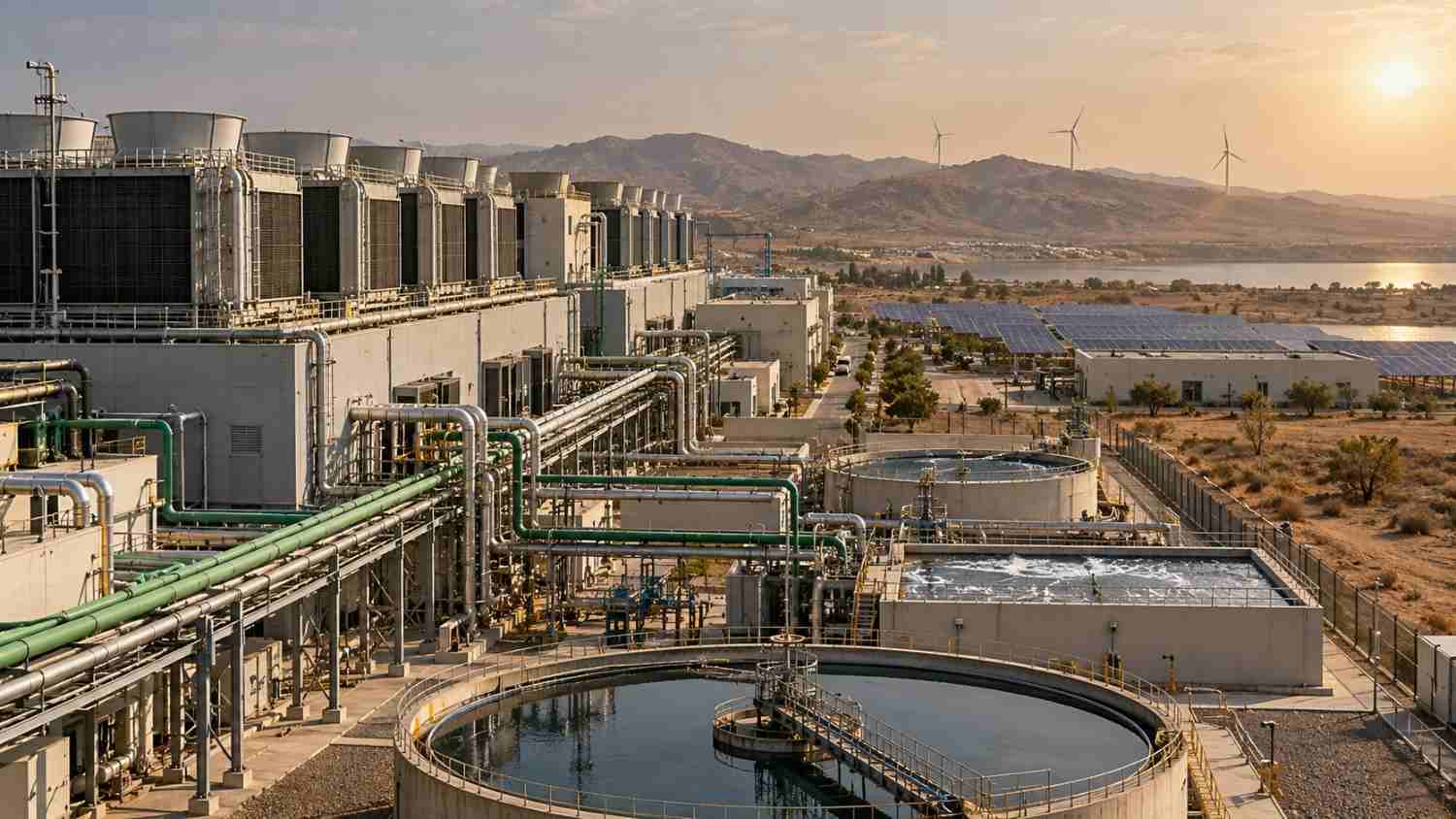
India is preparing to host an expanding artificial intelligence economy on an electricity system already being tested by hotter nights, rising cooling demand and uneven local infrastructure. The danger is that digital ambition becomes an excuse to prolong dependence on coal, appropriate scarce water and transfer infrastructure costs to ordinary consumers. A different outcome is possible. AI investment could finance cleaner electricity and more resilient networks, provided public policy makes those contributions a condition of expansion.
Shankar Sharma’s Counterview article rightly connects India’s power difficulties with the growth of data centres and the climate crisis. Its emphasis on distributed renewables, storage and managing demand offers a useful starting point. But the argument becomes stronger when we distinguish installed machinery from electricity delivered, long-range forecasts from present consumption, and decentralisation from an assumption that national networks have become dispensable.[1]
The paradox begins with installed capacity. As of September 30, 2026, India had approximately 558.8 gigawatts of installed electricity capacity. Ministry of New and Renewable Energy figures put renewable capacity, including large hydropower, at 299.25 GW, or about 53.6% of that total. Adding nuclear takes non-fossil capacity to 308.03 GW, approximately 55%. Renewables are already a majority of installed capacity; their contribution to actual generation remains much smaller.[2,3]
Electricity source | Installed capacity |
|---|---|
Coal lignite gas and diesel combined | About 250.8 GW |
Solar | 171.05 GW |
Wind | 59.20 GW |
Large hydropower | 52.06 GW |
Small hydropower | 5.18 GW |
Bioenergy and waste to energy | 11.75 GW |
Nuclear | 8.78 GW |
Total | About 558.8 GW |
Capacity snapshot at September 30, 2026. Rounded figures; large hydropower includes pumped storage. The fossil total is calculated from the reported overall and non-fossil totals.[2,3]
The generation picture explains the paradox. The ministry’s April 2026 summary reported approximately 1,846 terawatt-hours of electricity generated in 2025–26. Fossil fuels supplied about 71%, renewables including large hydro about 26%, and nuclear roughly 3%. Renewables excluding large hydro contributed around 17%; solar and wind together approximately 15%. A terawatt-hour equals a billion electricity units. These annual shares, rather than capacity announcements alone, reveal how far India still has to travel.[4]
Electricity also has to pass through an institutional and physical chain. Central utilities, state companies and private developers generate it; interstate and state networks transport it; distribution companies deliver it through substations, transformers and local feeders. Grid operators balance supply and demand continuously. Regulators determine tariffs and network access, while governments influence subsidies and investment. Captive industrial plants and local systems add further layers. Installing a solar panel solves one part of this chain.
This is also a federal system. State regulators and utilities shape local delivery, while central institutions oversee interstate networks and national coordination. Power purchase contracts, open-access rules and electricity markets influence which plant supplies which consumer. Industrial captive generation and cross-border electricity trade add options. The resulting mix must provide voltage control, reserves and other services as well as sufficient annual energy. Electricity policy therefore cannot be reduced to a contest between two generation technologies.
National adequacy can therefore coexist with poor service at a particular household or workshop. The government reported an aggregate energy shortfall of only 0.1% in 2024–25, a substantial improvement on earlier shortages. That measure cannot establish that every feeder has reliable voltage or every consumer receives uninterrupted supply. Local breakdowns, distribution constraints and difficulties purchasing power remain consequential even when national annual supply appears sufficient.[5]
Several forces explain coal’s continuing dominance. Solar produces during daylight, with output affected by cloud, dust and temperature. Wind varies across seasons and locations. Hydropower depends on rainfall, river conditions and competing water uses. An installed gigawatt of solar consequently delivers fewer annual units than a gigawatt of coal operated for much of the year. Solar’s rapid recent expansion also means the year-end capacity figure includes plants that did not generate for the entire preceding year.
Coal has an accumulated institutional advantage: established plants, fuel logistics, contracted payments and operating practices. Replacing its annual energy output also requires replacing the reliability services it provides at particular hours. Existing assets and long contracts can discourage change. Yet the transition still has to deliver dependable power through long summer nights and weak renewable periods. India needs cleaner firm supply and flexibility that can actually be dispatched when required.
Geography compounds the difficulty. Renewable resources are concentrated in particular states, while electricity must serve widely dispersed industries and cities. A generating station may be commissioned before the transmission line or substation needed to carry its output. Congestion, inadequate flexibility and operational restrictions can force renewable generators to reduce production even while another area needs electricity. Such curtailment represents a failure to coordinate generation, networks and demand; installing further capacity alone cannot resolve it.[6]
Investment must follow that diagnosis. The government’s July 2026 parliamentary reply identified an estimated ₹9.16 lakh crore of transmission investment under the 2022–32 National Electricity Plan. The critical issue is coordinated execution: renewable plants, lines, substations and storage must become usable together. Modern grid-support equipment and capable inverters also matter as the generation mix changes. Public reporting should show electricity successfully delivered and reliability achieved, alongside expenditure and kilometres of line constructed.[9]
Distribution reform is equally important. National aggregate technical and commercial losses fell from 21.91% in 2020–21 to 15.04% in 2024–25. This indicator includes billing and collection problems alongside physical losses; treating the entire percentage as electricity disappearing from wires would be misleading. Better conductors, transformers and maintenance can save energy, while accurate billing and timely subsidy payments improve the finances needed to purchase clean power and maintain service.[5]
Rooftop solar can complicate those finances when higher-paying consumers buy less grid electricity while the distribution company retains network costs and subsidised customers. Regulators should reward utilities for integrating local generation, maintaining reliability and reducing physical losses. Transparent compensation for network services and timely public funding of social subsidies would help prevent a transition in which affluent consumers capture the benefits and poorer households inherit rising costs.
Energy efficiency deserves comparable investment. Efficient motors and pumps, reduced industrial waste and better building design can relieve demand without reducing useful services. For scale, an illustrative saving equal to 5% of the reported 2025–26 generation would amount to roughly 92 TWh. This is an arithmetic comparison, not a forecast of achievable savings. It nevertheless shows why public policy should compare the cost of avoiding waste with the cost of adding generation and networks.
Distributed energy offers a substantial opportunity because production can be placed close to useful demand. School roofs, hospitals, railway premises, warehouses and factories can generate electricity where daytime consumption already exists. India’s grid-connected rooftop solar capacity reached 33.41 GW by September 2026. The scale is becoming significant, but installation quality, maintenance and usable electricity matter as much as the number of beneficiaries announced.[2]
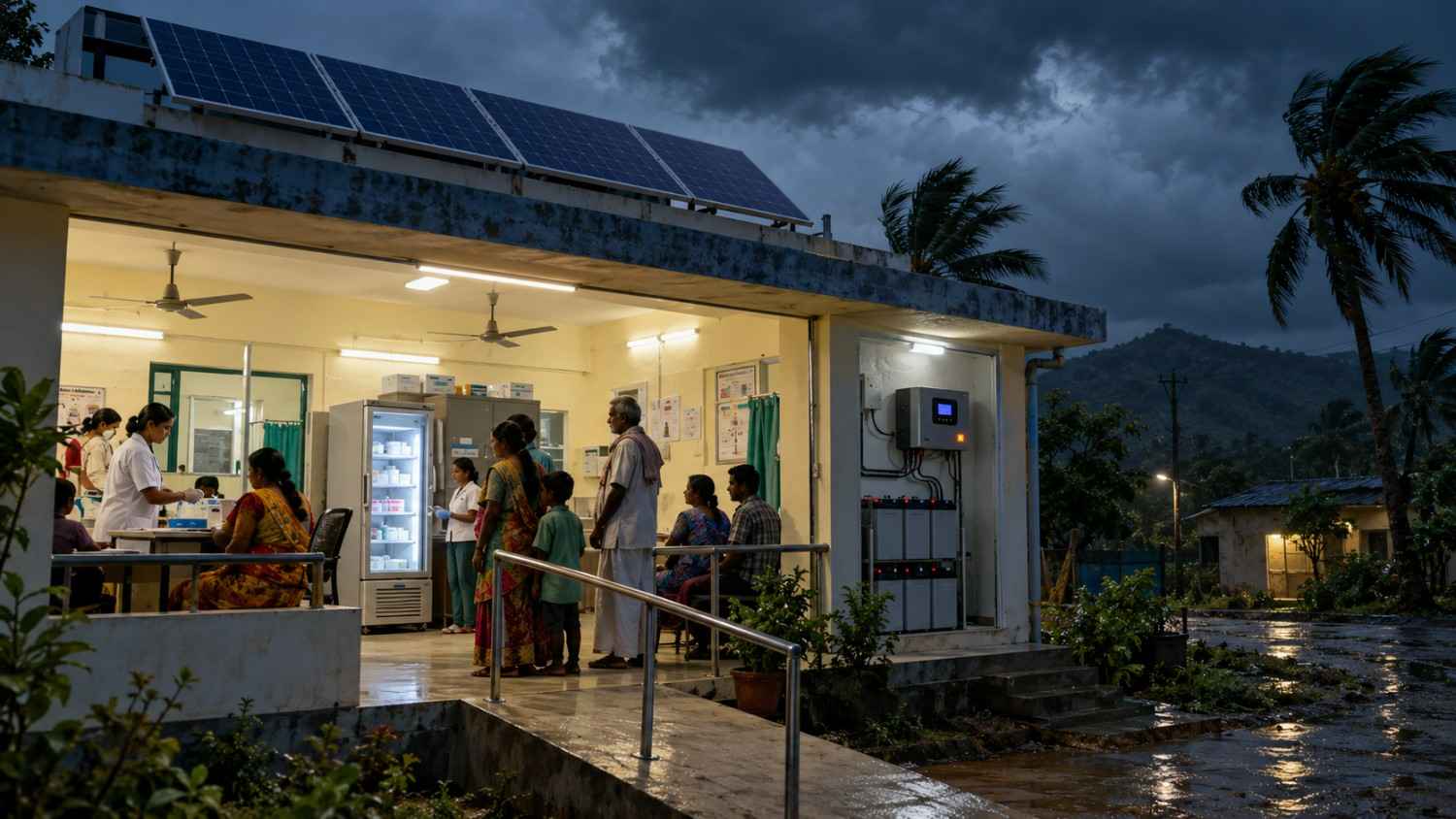
For a school or primary health centre, solar paired with properly sized storage can support fans, lighting, communications and essential refrigeration during interruptions. In cyclone-exposed places such as the Sundarbans, such systems should be designed around emergency services, elevated equipment and local repair capacity. Ordinary grid-connected solar usually disconnects during an outage for safety. Continuing service requires appropriate controls, storage and equipment that can operate safely apart from the grid.
Gujarat’s Dhundi solar irrigation cooperative demonstrates how institutional design can improve the value of a technology. Farmers use solar electricity for irrigation and sell surplus power to the utility. Payment for electricity creates an incentive to conserve energy and water, instead of pumping merely because sunlight appears free. The broader lesson is that solar irrigation needs groundwater safeguards and remunerative export arrangements; otherwise cheap pumping can aggravate depletion.[7]
Access must extend beyond households that own suitable roofs and can obtain loans. Community solar, shared installations for apartments, public buildings and affordable service contracts can include tenants and poorer families. Local technicians need training, spare parts and viable maintenance businesses. Decentralisation becomes meaningful when communities gain dependable service and bargaining power, rather than responsibility for equipment they cannot afford to repair.
Sustainable expansion also requires discipline about land and materials. Agrivoltaics can combine farming with electricity production where crop choice and design permit, while carefully sourced agricultural residues can support local bioenergy. Neither label guarantees environmental benefit. Food production, biodiversity, soil needs and air quality require protection. Batteries and solar equipment need repair, collection and recycling systems. A clean electricity transition should reduce environmental burdens over its lifecycle rather than relocate them.
Storage then connects generation with the hours when electricity is needed. A battery rated at one gigawatt with four gigawatt-hours of usable energy can deliver full output for roughly four hours; the power rating alone says little about endurance. Batteries can absorb solar production, reduce evening peaks and respond quickly to disturbances. Longer shortages require a portfolio of resources. Pumped storage may help where environmental assessment supports it, but neither batteries nor reservoirs create energy.
Virtual power plants can coordinate rooftop batteries, controllable pumps and electric-vehicle charging as a collective grid resource. Time-sensitive tariffs can encourage willing consumers to shift flexible activity towards plentiful supply. These arrangements require dependable communications, cybersecurity and consumer consent. Essential cooling and medical needs need protection. Demand management should reward flexibility; it should not become a sophisticated means of rationing electricity to people with little political influence.
A distributed revolution nevertheless needs a strong wider grid. Regional connections allow electricity to move between different weather conditions and demand patterns. Large renewable parks can complement local generation. Nuclear can provide low-carbon electricity, although it is not renewable and its costs, construction times, water requirements and waste obligations require scrutiny. Each investment should be assessed against realistic alternatives. Blanket rejection of transmission, nuclear or pumped storage would narrow India’s options prematurely.
AI introduces a new concentration of demand into this complicated transition. The International Energy Agency’s 2026 update estimates that global data-centre electricity consumption reached 485 TWh in 2025 and could rise to approximately 950 TWh by 2030. AI-focused facilities grew faster than the sector overall. These totals cover data centres, including other digital services; they should not be presented as the footprint of generative AI alone.[8]
For India, the government told Parliament in July 2026 that AI data centres could add 26.3 GW of load by 2031–32, expected to be integrated into the grid and primarily served by renewable capacity. Separately, Wood Mackenzie projected Indian data-centre electricity use reaching 191 TWh by 2040. That is the year attached to the striking figure cited in the Counterview discussion. Both are forecasts with different boundaries and units, rather than measurements of today’s consumption.[9,10]
The investment commitments are substantial. Google announced a $15 billion programme for an AI hub in Visakhapatnam and reported breaking ground in April 2026. Its plans include gigawatt-scale computing, transmission, clean generation and storage. Such commitments show how computing and electricity infrastructure are becoming linked. They also create a clear public test: whether promised energy and community benefits are delivered alongside the computing capacity, with independently verifiable results.[11]
The arithmetic makes the stakes tangible. An illustrative facility with 100 megawatts of continuously operating IT equipment and a power usage effectiveness of 1.2 would draw 120 MW overall, consuming approximately 1.05 TWh annually. That calculation assumes full utilisation throughout the year; real demand varies. Power usage effectiveness measures total facility electricity against IT electricity. It can identify cooling and electrical overheads, but cannot tell us whether the computing itself performs useful work efficiently.
The immediate pressure can be highly local. A large facility may need new transformers, redundant connections and substantial dependable supply in one urban corridor. AI equipment also produces rapid power fluctuations that require careful management. Some training and batch processing can move to different hours or locations; interactive services have tighter response requirements. Operators should disclose and contract the flexibility they can genuinely offer, rather than promising that every workload can follow sunshine.[8]
Water makes siting especially consequential. Cooling can consume water directly, and electricity generation adds an indirect water footprint. Liquid cooling at the chip does not by itself establish that the entire facility uses little water: heat still has to be rejected somewhere. Treated wastewater, dry cooling and hybrid designs deserve site-specific evaluation, including energy trade-offs. A low-carbon electricity contract cannot compensate a neighbourhood for an aquifer depleted during summer.
Green AI addresses the computing side of this problem by treating environmental performance as a lifecycle discipline. Accounting must include experimentation, training, routine inference, cooling, hardware manufacture and eventual disposal. It must also preserve useful performance. A smaller model that repeatedly fails, triggers retries or demands extensive correction may consume more resources per completed task than a better-designed alternative.[12]
Practical choices begin with selecting the smallest system that reliably accomplishes the task. An Indian-language information service may need a specialised model grounded in approved documents, rather than a frontier model for every request. Quantisation reduces numerical precision and memory requirements; distillation transfers capabilities to smaller models. Caching avoids repeated calculations, while efficient batching can improve hardware utilisation. Savings depend on workload and implementation, so procurement should require measurement rather than assume that any technique guarantees lower impact.
Model cascades send simpler requests to smaller models and reserve more demanding systems for difficult work. The FrugalGPT research reported reductions of up to 98% in inference cost on selected benchmarks while matching a stronger individual model’s performance. That finding supports selective routing. It does not establish a universal 98% reduction in electricity or carbon emissions, because commercial prices and physical resource use are different measures.[13]
Autonomous agents need additional restraint. A single instruction can generate repeated searches, model calls and unsuccessful attempts. Limits on steps, output length and retries, together with detection of unproductive loops, can reduce waste. The relevant question is how much energy a successfully completed task required, including failed attempts. Evaluations should test quality on Indian languages and real operating conditions, where poor performance could erase apparent savings.
Measurement should make comparisons fair. Google’s study reported 0.24 watt-hours for a median Gemini Apps text prompt in May 2025. This was a company-specific, dated observation, not a universal footprint for AI. Longer reasoning, video generation and agent workflows can require substantially more energy. Organisations should publish task definitions and quality thresholds alongside facility-adjusted electricity, emissions, water and hardware impacts, with annual absolute totals to expose growth hidden by improving averages.[14]
Energy procurement needs similar honesty. Matching annual consumption with renewable purchases does not prove that clean electricity was available in the relevant grid every hour. A data centre can claim annual matching while relying on fossil generation after sunset. Contracts that support additional clean capacity, storage and verifiable hourly matching offer a stronger pathway. India should progressively tie fiscal incentives and public AI contracts to that standard, while requiring disclosure of residual fossil dependence.[15]
Efficiency alone cannot guarantee falling demand. If electricity per task halves while the number of tasks quadruples, total use doubles. This rebound effect makes absolute resource budgets and scrutiny of applications necessary. Public agencies should favour demonstrable services such as accessible information, grid forecasting or carefully validated agricultural advice. Deploying computationally intensive systems for routine functions without comparing simpler alternatives wastes both money and scarce infrastructure.
AI can also help the transition by improving renewable forecasts, detecting equipment faults, managing charging and coordinating storage. These uses should be evaluated against a credible baseline: how much additional renewable electricity was delivered, how much physical loss was avoided, and what reliability improved? Emissions savings claimed elsewhere in the economy should be reported separately from a company’s own footprint. Promised benefits cannot substitute for controlling the resources consumed by the AI system.
Climate change makes delay increasingly expensive. The IEA’s analysis of May 2026 showed India reaching 270 GW of peak demand on May 21, with rising nighttime cooling needs becoming a particular challenge as solar output disappears. It projects cooling demand more than doubling by 2035 under current policy settings. Efficient air conditioners, building standards, shade and passive cooling therefore belong inside electricity strategy, alongside new generating capacity.[16]
Climate hazards also weaken supply. Drought can constrain thermal-plant cooling and hydropower; floods and cyclones can damage substations and lines. IEA and CEEW analysis has documented the vulnerability of India’s coal fleet to water stress. Adding data-centre demand without planning for these conditions risks a damaging feedback: more fossil generation increases emissions, warming raises cooling requirements, and heat and water constraints make reliable electricity harder to provide. Local resilience and emissions reduction must advance together.[17]
India should require large data-centre proposals to demonstrate grid readiness, additional clean supply, credible water budgets and climate-resilient design before receiving major concessions. Developers should pay a fair share of attributable network costs and provide financial safeguards against abandoned expansion plans. Regulators should publish connection queues and resource commitments. Communities need accessible information and enforceable service protections. These requirements would turn investment announcements into obligations that citizens can assess.
The wider transition must protect coal-dependent workers and districts through retraining, economic diversification and rehabilitation of damaged land. It should also build Indian capabilities in storage, power electronics, efficient models, maintenance and environmental auditing. Renewable deployment offers greater public value when its supply chains, employment and ownership opportunities are deliberately developed, and when affordable electricity remains a central measure of success.
AI becomes a long-term curse for Indian sustainability if unlimited computing is treated as an entitlement while clean electricity, water and climate stability become somebody else’s problem. India cannot stop global warming by itself, but it can decide how its digital expansion affects emissions and resilience. The test is whether AI helps deliver worthwhile services within a declining environmental burden. A future that requires sacrificing reliable household electricity and water to sustain ever-growing computation would fail that test.
Sources and data notes
Capacity data are dated September 30, 2026. Generation shares refer to the ministry’s April 2026 summary for FY 2025–26 and are rounded. Forecasts are identified separately from measured consumption. The main feature is approximately 2,930 words, including the capacity table and its note.
[1] Shankar Sharma, India’s power paradox, Counterview, 18 October 2026
[2] MNRE, Physical Achievements, capacity data at 30 September 2026
[3] Akashvani, India at the East Asia Summit Energy Ministers’ Meeting, 8 October 2026
[4] MNRE, India Ranks Third Globally in Renewable Energy Installed Capacity, 8 April 2026
[5] Ministry of Power, Availability and Quality of Power Supply, 12 March 2026
[6] IEA, Renewables Integration in India, 2021
[7] IWMI, Solar Irrigation for Agricultural Resilience, Dhundi cooperative account
[8] IEA, Key Questions on Energy and AI, executive summary, 2026
[9] Ministry of Power, Rajya Sabha Unstarred Question 956, 27 July 2026
[10] Wood Mackenzie, India Data Centre Capacity to Reach 12 GW by 2030, 27 July 2026
[11] Google, Google AI Hub Scaling India’s AI Infrastructure and Community Impact, 28 April 2026
[12] Prof Ujjwal K Chowdhury, Building the Frugal Machine Inside the Real Push for Green AI, supplied document GreenAIDetails(2).docx
[13] Lingjiao Chen, Matei Zaharia and James Zou, FrugalGPT, 2023
[14] Google, Measuring the Environmental Impact of Delivering AI at Google Scale, August 2025
[15] Google, Clean Energy 24x7 Carbon Free Internet, annual versus hourly matching
[16] IEA, India’s Electricity Demand Grows at Night, 3 June 2026
[17] IEA and CEEW, Managing the Water Energy Nexus Is Vital to India’s Future, 22 March 2021






Add a Comment