
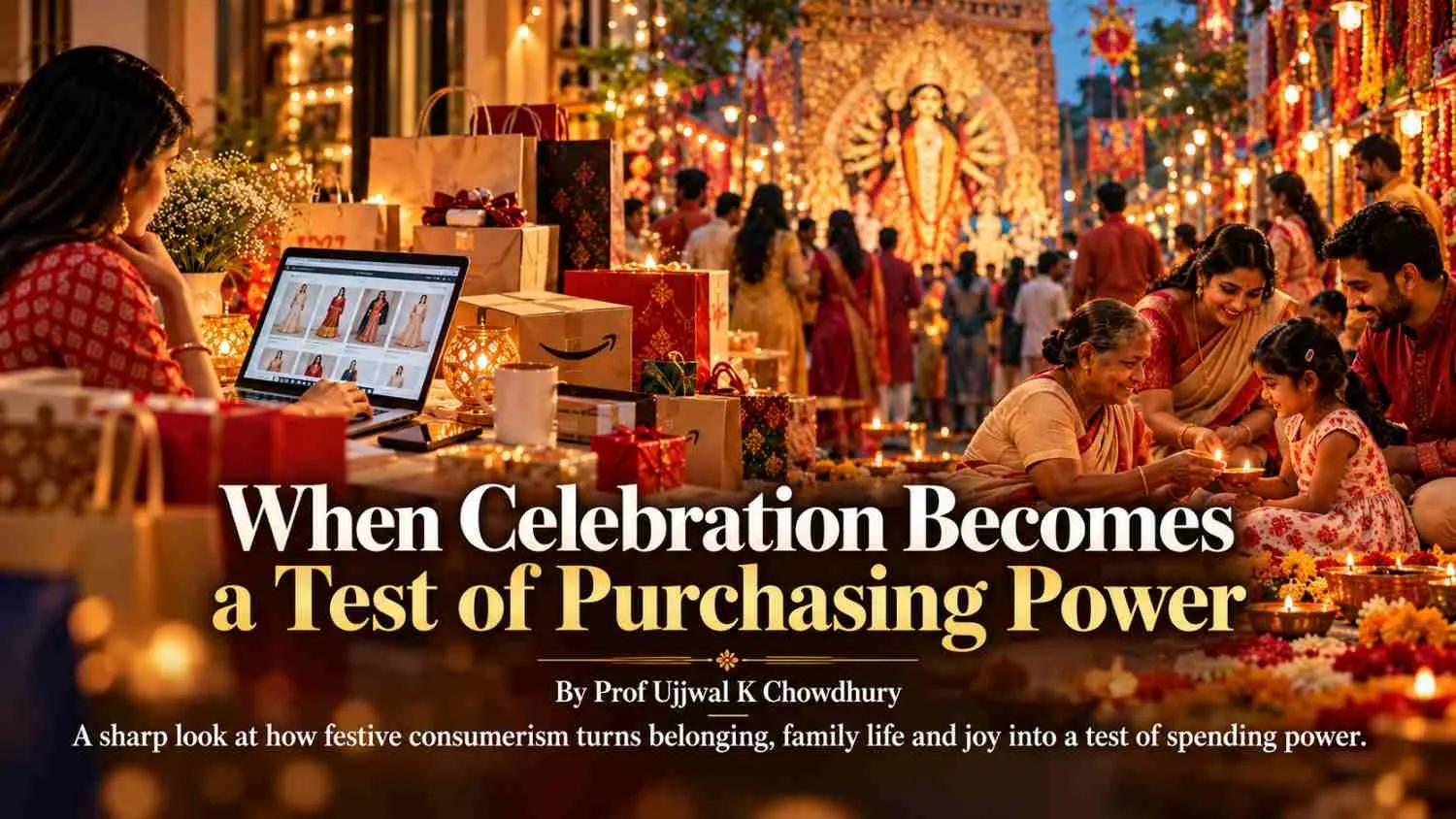
| Prof Ujjwal K Chowdhury explores consumerism, family life and the search for meaning in South Asia’s festival seasons |

The Festival Arrives in the Cart
For many connected households, the festival now arrives as a notification. Before relatives have agreed when to gather, screens announce discounts, delivery deadlines and the possessions supposedly essential to celebration. There are clothes to refresh, homes to transform, gifts to upgrade and experiences to reserve. A season promising release from everyday pressures begins by issuing fresh instructions.
The promise is seductive because it borrows from our deepest desires: to belong, to be appreciated, to make our children happy, to feel that life has moved forward. Consumerism attaches a transaction to each longing. Gradually, purchasing power begins to stand in for the ability to love and live meaningfully.
Bhabani Shankar Nayak’s Counterview essay, “The desolation of our times,” examines how brands become measures of identity and human worth. India’s festival seasons offer an intimate setting for considering that concern: who decides what makes a life valuable, and why have commercial answers acquired such authority?
When Belonging Gets a Price Tag
Festivals have always involved material things. A sari, a sweet, a clay lamp or a child’s new shoes can carry affection, memory and dignity. Seasonal purchases sustain weavers, potters, tailors, flower sellers, cooks and shopkeepers. For someone emerging from deprivation, buying a good garment may represent a hard-won freedom.
The damaging change occurs when spending becomes an admission requirement for social respect. A present chosen with care enters a different moral world when its price becomes evidence of commitment. An affordable celebration becomes humiliating when everyone is expected to demonstrate prosperity.
Consumption becomes consumerism when acquisition expands from one activity within life into its organising principle. The question shifts from whether something serves us to whether possessing it makes us appear successful. That distinction matters especially in an unequal society: preaching simplicity to someone struggling for necessities can be insulting, while questioning compulsory display can defend that person’s dignity.
Garba, Glamour and the Missing Neighbour
Navratri’s diverse traditions encompass worship, fasting, music and community participation. Consider an urban garba celebration where admission, fashionable clothing, accessories and photographs accumulate into a substantial expense. Dancing may remain joyful. Yet someone repeating an outfit or unable to afford a pass may experience participation as an examination.
Commercial events can provide employment and professional entertainment. Trouble begins when their expensive versions become the standard against which ordinary celebrations are judged. A neighbourhood gathering risks appearing inadequate because it offers fewer purchasable distinctions.
Durga Puja presents a related tension. Its pandals can bring remarkable art into public space, sustain craftspeople and create encounters across social boundaries. Such public splendour can enrich collective life. But competition over scale, publicity and prestige can also overshadow whether ordinary visitors feel welcome and comfortable.
A spectacular structure and an inclusive festival are separate achievements. The care shown to an elderly visitor, a disabled person or a family unable to spend deserves as much attention as the photograph of the installation.
Diwali and the Compulsory Upgrade
Diwali intensifies these pressures through its associations with renewal, prosperity and homecoming. Cleaning a room can expand into an expectation to redecorate it. Giving sweets becomes a contest between elaborate hampers. A functioning appliance suddenly appears embarrassing beside its discounted replacement.
Even corporate gifting can become an exercise in ranking: the packaging announces the importance assigned to a recipient. The festival’s vocabulary of affection is recruited into professional calculation.
Within households, the promise becomes more intimate. An advertisement can imply that improving the home means improving the family’s life. But an upgraded television cannot settle an unresolved grievance. Matching clothes cannot ensure that people listen to one another.
When objects are asked to perform emotional work beyond their capacity, disappointment follows. Another purchase then appears with the same excessive promise. Meanwhile, the difficult conversation remains postponed, and the family’s limited time together disappears into arranging its possessions.
Eid Between Giving and Display
Ramadan and Eid al-Fitr occur elsewhere in the calendar; they belong here as another recurring season of South Asian consumption. In Lucknow, Hyderabad, Dhaka and Lahore, new clothes, food, gifts and Chand Raat’s bustle can express delight and reunion. Traditions of restraint, generosity and concern for others also offer resources for questioning excess.
A premium iftar buffet, an expensive outfit or a carefully staged Eid photograph can nevertheless become a measure of successful celebration. Competitive hospitality leaves households with fewer resources choosing between overspending and embarrassment.
Generosity itself can become performative. Photographing a charitable act may encourage others to contribute, but the recipient’s dignity deserves priority over the giver’s public image. Help becomes troubling when someone else’s vulnerability supplies material for our reputation.
The same commercial logic travels across religious boundaries, borrowing each community’s symbols. It offers an appearance of fulfilment that may have little connection with the ethical demands of the occasion.
The Algorithm at the Family Table
The commercial use of emotion is explicit in marketing literature. Google’s 2025 Ramadan guidance advises advertisers to draw on family, community and giving, and emphasise deals as Eid approaches. Meta’s Indian festive playbook promotes creators, personalised advertising and short videos as routes to purchases. These corporate strategies reveal how intimate festival associations become tools for directing expenditure.
Digital platforms also widen the circle against which people compare themselves. Earlier generations knew status rivalry. Today, an ordinary household encounters professionally arranged celebrations, influencer wardrobes and exceptional holidays in a continuous stream. Someone else’s exceptional moment becomes a daily reference point.
Young people can recognise that an image is curated and still feel diminished beside it. Understanding the mechanism does not cancel the need for recognition. A student may begin judging friendships through restaurant visits, branded clothes and the events a group can afford.
The pressure becomes particularly cruel when visible success is demanded from people whose education, employment or income remains uncertain. A structural problem of opportunity is experienced as personal inadequacy.
Buy Now, Worry Later
Nor is every purchase the result of unhurried consideration. India’s consumer authorities identified practices including false urgency, disguised advertising and confirm shaming in the 2023 dark-pattern guidelines. A fabricated deadline can turn uncertainty into an immediate transaction.
Credit then separates the pleasure of acquiring something from the discomfort of paying. Instalments can make necessary purchases manageable. Trouble begins when avoiding social embarrassment justifies obligations a household cannot comfortably carry. The festival ends; repayments enter conversations about groceries, school expenses and emergencies.
Nayak’s companion article on the American Dream questions whether corporate performance adequately represents shared prosperity. That question applies to festival economics too. Sales figures reveal commercial activity; they cannot establish household security or human fulfilment. A seller’s successful season may coexist with a buyer’s financial strain.
Celebration becomes a particularly effective market because spending can feel morally compulsory. Refusing an unnecessary object appears to risk disappointing someone we love. The pressure reaches us wearing the face of affection.
Love Starts Keeping Accounts
Inside families, these expectations can alter the language of care. A child’s disappointment over a device may be heard as ingratitude. A parent’s financial limit may be heard as indifference. Partners compare gifts, restaurants or holidays with those displayed by other couples.
There is nothing inherently shallow about wanting a present. Being remembered matters. Harm arises when expensive gestures become compulsory proof of remembrance, crowding out practical help, patience, forgiveness and dependable companionship.
Children learn from the standards adults establish. If every festival requires a larger reward, anticipation can become an exercise in escalation. Making rangoli together, learning a song or helping prepare food offers another kind of satisfaction: contributing to an occasion rather than waiting to be supplied with it.
Older relatives may face a different exclusion. A gathering organised around photographs and rapid posting can leave someone physically present but barely heard. The family portrait is complete; the conversation with the person inside it remains unfinished.
Joy Has No Audience Requirement
Joy and show need not be the same. Joy concerns how an experience is lived. Show concerns how it appears to others. They can meet in a magnificent dance performance, a beautiful pandal or an exuberant family celebration. Yet neither expense nor visibility guarantees the feeling.
Consider a family meal repeatedly interrupted to rearrange plates, correct someone’s expression and record another version of a supposedly spontaneous moment. Everyone may eventually look delighted. The labour of appearing happy may have displaced the happiness available in simply eating together.
Conversely, an ordinary meal after a tiring journey can bring immense joy because someone has waited for us. Its emotional richness comes from recognition, relief and affection. These qualities resist measurement through price.
Research by Alixandra Barasch, Gal Zauberman and Kristin Diehl found, across field and laboratory studies, that taking photographs for sharing could reduce enjoyment compared with taking them for oneself. Concern about others’ impressions helped explain the effect. The findings concern particular conditions, rather than establishing that photographing or sharing is inherently harmful.
The distinction is useful. A photograph can preserve delight or connect distant relatives. But when the imagined audience directs the evening, people can become performers in their own lives.
Joy also allows imperfection: a burnt sweet, an old joke, an unplanned visitor, a sari worn before. Display becomes exhausting when such ordinary details threaten the image. One practical question exposes the difference: would we still want this experience if nobody outside it ever knew?
The Quiet Values Lose Their Place
Comparison can make satisfaction feel premature. Someone else possesses more, travels further or celebrates more spectacularly. Gratitude becomes difficult when attention is continually redirected towards a deficiency.
A 2014 meta-analysis by Helga Dittmar and colleagues, covering 259 independent samples, found that materialistic orientations were associated with lower well-being. This does not establish that any particular purchase causes distress. It does challenge the assumption that making acquisition central to life reliably improves it.
The deeper change concerns what earns admiration. Patient care, intellectual curiosity and loyalty through difficulty seldom produce a dramatic reveal. They take time and may remain unseen. When novelty and visibility dominate recognition, people can invest in what is displayable while postponing what requires sustained attention.
A meaningful life includes grief needing company, conflict needing honesty and ageing needing patience. Treating these ordinary conditions as failures requiring another upgrade makes people less able to inhabit their lives compassionately. Even sadness deserves room during a festival.
Even Escape Comes in a Package
The market also sells an apparent escape from shopping through curated experiences: the festive resort break, the exclusive concert, the premium wellness weekend. These can bring pleasure and renewal. Their value still depends on what people experience, rather than the desirability of the package.
Consider a holiday chosen mainly because everyone seems to be posting from that destination. The family may spend its limited leave pursuing crowded attractions and photographic landmarks while the conversation it needed never happens. Another household may spend an afternoon playing cards with cousins and feel deeply restored.
An expensive retreat cannot, by itself, repair a working life that allows no ordinary rest. When every remedy must be purchased, the conditions producing exhaustion escape scrutiny. Festival freedom should include wandering, reading, sleeping, talking and doing very little. Unscheduled time can be valuable even when it supplies no impressive story afterwards.
Whose Festival, Whose Work?
Festival spectacle can conceal unequal labour. The immaculate home may depend on an exhausted family member, frequently a woman, managing cooking, cleaning, shopping and the emotional responsibility of keeping everyone pleased.
Convenience may depend on delivery workers, cleaners and retail staff whose own celebrations are constrained by work. A migrant worker helping prepare another family’s reunion may be unable to travel home. An account of happiness confined to the customer’s experience leaves such relationships outside its view.
Buying prepared food or paying for assistance can ease burdens. Fair payment, reasonable expectations, time off and shared domestic work matter more than nostalgia for an allegedly simpler past.
Consider the contradiction of bargaining relentlessly with a potter over a few lamps while accepting a substantial charge for branded packaging. The distinction reveals whose labour we have learned to value. A celebration gains ethical depth when the people making it possible share in its benefits.
The Morning After the Lights
There is also a material afterlife to the performance: disposable decorations, elaborate packaging, surplus food and garments unlikely to be worn again. A household’s brief impression can become a prolonged burden for waste workers and public spaces.
The government’s 2023 Swachh Diwali campaign encouraged avoiding single-use plastics, waste segregation, and reducing, reusing and recycling. The underlying principle deserves attention beyond a seasonal appeal: what remains after celebration belongs within its moral account.
Environmental concern can itself become another premium shopping category. A costly “green” gift may feel reassuring while the possibility of buying less, repairing something or reusing decorations receives little attention.
Repeated use can carry emotional value. Lamps brought out each year, inherited utensils and familiar decorations link occasions across time. Their continuity offers something the demand for perpetual novelty struggles to recognise: pleasure can deepen through familiarity.
Let Celebration Be Shared Again
Recovering that possibility requires more than individual self-control. Affordable public celebrations, libraries, parks and accessible cultural spaces offer ways to gather without continually paying. Organisers can judge success through welcome, participation and care alongside attendance and publicity.
Schools can help young people examine advertising, sponsorship and the difference between an attractive image and an adequate life. Communities can support skilled local producers through fair prices and prompt payment.
Households can agree on spending limits, welcome repeated clothes and simple gifts, share the work and leave part of the gathering unrecorded. These choices become easier when openly shared, so nobody feels privately obliged to sustain an unaffordable appearance.
Such changes should expand freedom. Earlier communities could enforce hierarchy, restrict women and exclude outsiders. Privacy, independence and chosen relationships can be deeply valuable. A humane festival welcomes different ways of belonging, including people who do not observe its religious rituals.
Generosity can mean allowing someone time off, including a lonely neighbour, visiting an older relative or listening without checking a screen. Its worth need not depend on a public announcement.
Enough Can Be a Beautiful Word
A festival’s deepest promise is a temporary enlargement of ordinary life: room for memory, hope, affection and one another. That promise weakens when every gesture must prove prosperity and every pleasure must establish rank.
Imagine leaving a celebration certain that your presence mattered, comfortable with what you could afford and grateful for those who shared the evening. There would still be food, clothes, music, lamps and gifts. Their meaning would grow from the relationships around them.
We deserve celebrations from which people return less ashamed of their circumstances and more assured of their place among others. Joy becomes possible when belonging feels secure. And the fullest evening may be one in which nobody has anything left to prove.



Add a Comment