
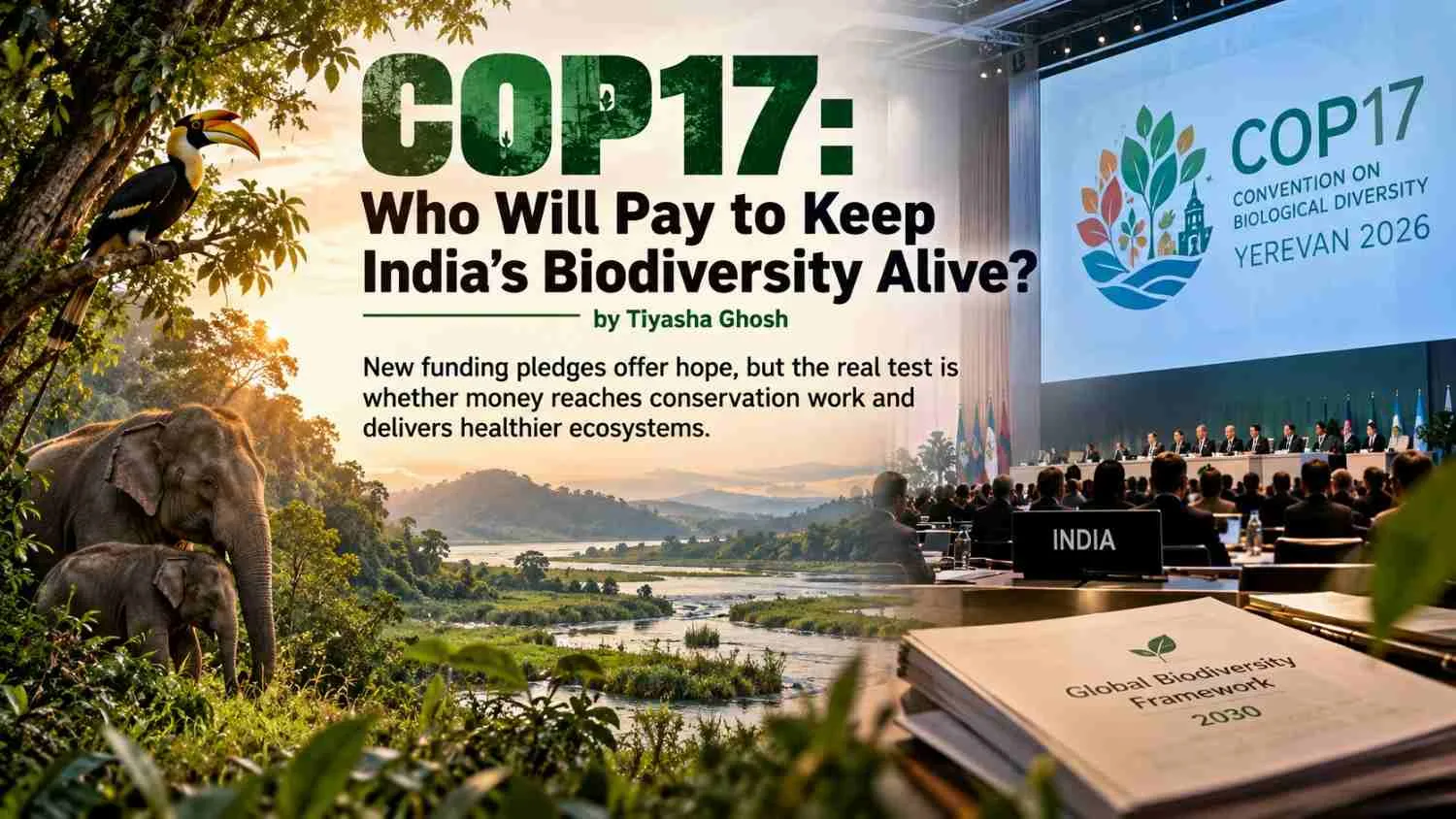
27 October 2026 | Kolkata, India
| New funding pledges offer hope, but the real test is whether money reaches conservation work and delivers healthier ecosystems. |
| Summary: The UN Biodiversity Conference in Yerevan is reviewing global progress towards the 2030 nature targets. India reports that all 23 of its national biodiversity targets are on track, but the UN’s global assessment warns that progress remains insufficient. New funding pledges at COP17 raise a critical question: how much money will reach conservation projects and communities, and how will countries prove that nature is recovering? |
If Countries Promise to Protect Nature, Who Will Pay - and How Will We Know It Works?
A forest can be marked for protection on a map, a wetland can be assigned a restoration target, and a government can announce new funding. But none of these steps automatically guarantees that wildlife habitats are recovering or that local communities are benefiting.
This is the central question at the 17th Conference of the Parties to the Convention on Biological Diversity (CBD COP17). Held in Yerevan, Armenia, from 19 to 30 October 2026, the conference is undertaking the first global review of progress under the Kunming–Montreal Global Biodiversity Framework. Adopted in 2022, the framework sets out 23 targets intended to halt and reverse biodiversity loss by 2030.
The issue is particularly important for India, where biodiversity supports food production, water systems, livelihoods, climate resilience and cultural practices. Protecting nature requires more than declaring protected areas. It also demands long-term financing, effective management, scientific monitoring and decisions that recognise the rights and knowledge of communities connected to these landscapes.
What Has India Promised - and What Does Its Progress Report Show?
India released its updated National Biodiversity Strategy and Action Plan (NBSAP) for 2024–2030 at CBD COP16 in October 2024. The plan outlines national priorities for conservation, sustainable use, ecosystem restoration and the fair sharing of benefits arising from genetic resources.
On 26 February 2026, India submitted its Seventh National Report to the Convention on Biological Diversity. The report assesses 23 national biodiversity targets through 142 indicators, drawing on information from 33 central ministries and departments, state governments, statutory authorities, research institutions and other stakeholders.
India’s official assessment describes all 23 national targets as “on track to achieve”. The report also records progress in conservation infrastructure and community biodiversity institutions. It lists 98 notified Ramsar wetlands as of 2026 and states that the National Biodiversity Authority had issued more than 5,600 access-and-benefit-sharing agreements, with ₹140 crore disbursed.
These figures indicate the scale of reported activity, but they do not establish that every wetland is healthy or that benefits are being distributed fairly among communities. Counts of institutions, agreements and protected sites are useful indicators of progress, but they need to be supported by evidence showing what has actually changed on the ground.
The wider global picture is more concerning. The United Nations’ State of Biodiversity Action report, launched on 18 October 2026, found that fewer than half of the assessed national targets were on track. It also identified gaps in financing, national ambition, implementation, data and international cooperation. Although many countries have prepared biodiversity plans, their targets do not always cover the full scope of the global framework.
India’s national assessment and the UN’s global findings are not directly comparable because they use different levels of analysis and sets of indicators. However, both highlight the same accountability question: what evidence shows that plans and reported progress are translating into healthier ecosystems?
Who Will Pay to Close the Biodiversity Finance Gap?
Financing has become one of COP17’s most important tests. On 26 October, the Global Environment Facility (GEF) announced more than $500 million in additional biodiversity-related pledges across the GEF and the Global Biodiversity Framework Fund (GBFF). The GEF’s ninth replenishment moved close to $4.4 billion, while new contributions of more than $60 million were announced for the GBFF. Contributors included Germany, Iceland, Monaco, the province of Québec and the city of Berlin, while Armenia confirmed its intention to contribute.
These announcements are significant, but their status matters. A pledge is a promise to contribute, not necessarily money that has already been transferred. A contribution received by a fund is not the same as a project being approved, and an approved project does not automatically demonstrate that the intended ecological results have been achieved.
The GBFF provides a useful example. The GEF reported that, since the fund’s launch in August 2023, it had received $446 million in commitments from 14 national and two subnational governments. It had programmed $362.1 million across 82 projects in 87 countries. In this context, “programmed” means allocated to projects; it should not be interpreted as proof that every dollar has reached its final recipient or delivered the intended results.
The debate is not simply about whether biodiversity needs more money. It is also about who should provide that money, how much should come from public budgets and international support, and whether developing countries can access the funds they need. Developing countries have called for stronger and more predictable financial support to implement global biodiversity targets. Funding institutions, meanwhile, also emphasise the role of private investment and blended finance.
Both approaches raise important questions. Public funding can provide a stable foundation, but it must be sustained over time. Private investment may expand the resources available, but projects must demonstrate genuine ecological benefits and include safeguards against treating biodiversity merely as a marketable asset.
For India, the practical test is whether funding is predictable, accessible and sufficient to support conservation work. Ecosystem restoration often requires years of maintenance and monitoring. Short funding cycles can leave restored sites without the staff, resources or community participation needed to protect earlier gains.
Who Receives the Money - and Who Gets to Decide?
Biodiversity is not protected by governments and large conservation organisations alone. Indigenous Peoples and local communities often maintain traditional knowledge, manage natural resources and depend directly on forests, wetlands, coastlines and other ecosystems.
Their participation matters because conservation decisions can affect access to land, forest produce, fishing grounds, grazing areas and culturally significant sites. A project may increase the area designated for protection on paper but still create difficulties if the people affected are excluded from decision-making or cannot access the funding intended to support them.
At COP17, the Wildlife Conservation Society called for more direct access to finance for Indigenous Peoples and local communities, meaningful participation in decision-making, recognition of customary territories and protection for environmental defenders. This is an advocacy position, not a final COP17 decision, but it highlights a practical test for conservation finance: whether the people most closely connected to ecosystems have a meaningful role in protecting them and benefit fairly from the resources allocated.
India has established Biodiversity Management Committees (BMCs) and People’s Biodiversity Registers (PBRs) to document local biological resources and associated knowledge. Its Seventh National Report recorded 2,76,653 BMCs and 2,72,648 PBRs.
These institutions can support local participation, but their numbers alone cannot establish whether committees have adequate resources, whether biodiversity records are regularly updated, or whether communities genuinely influence decisions and receive fair benefits. Those outcomes require evidence beyond the number of institutions established.
COP17 is also addressing the fair sharing of benefits arising from the use of digital sequence information on genetic resources. This refers to digital information derived from genetic material that can be used in scientific research and commercial development. The Cali Fund is intended to help address benefit-sharing from such uses. Its effectiveness will depend on how contributions are encouraged, how funds are distributed and whether benefits reach the countries and communities connected to those resources.
Are We Measuring Healthy Ecosystems - or Just the Area Covered?
A protected-area boundary, a count of planted saplings or a restoration target measured in hectares can show that an activity has taken place. None of these indicators, by itself, establishes that native species are returning, water flows are improving, soil is recovering or habitats are becoming sufficiently connected to support wildlife.
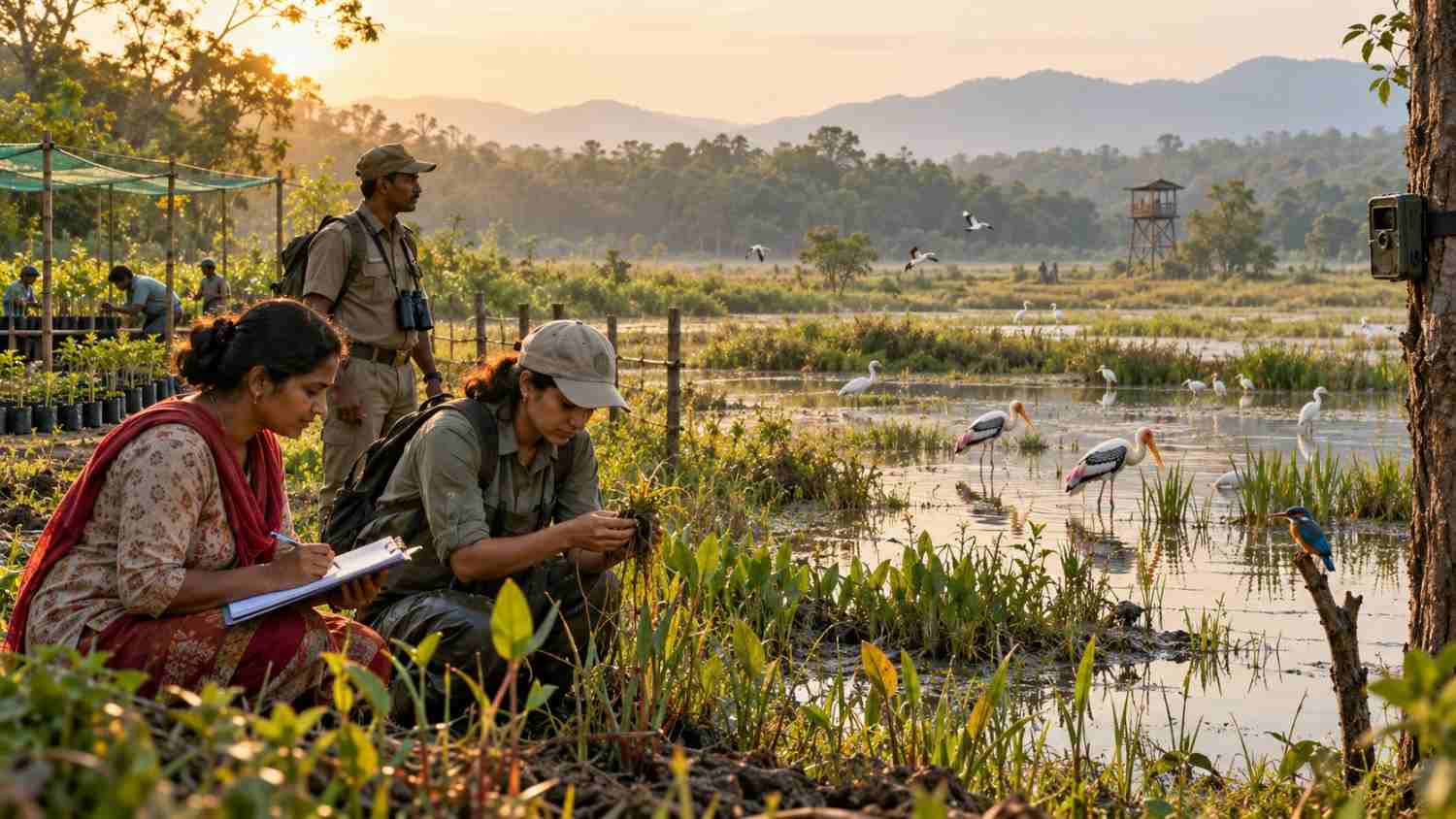
Consider a restored wetland. A planting drive alone cannot establish whether it is recovering. Water levels, pollution, native vegetation, wildlife and long-term management all influence whether the ecosystem is functioning properly. Forest restoration similarly requires attention to native species, sapling survival, habitat quality and the pressures that caused degradation in the first place.
This distinction is central to COP17’s review of implementation. A credible assessment should identify the ecosystem’s starting condition, the intervention undertaken, the period over which change is measured, the method used and the evidence supporting the reported result. Where data are missing, the gap should be acknowledged rather than replaced with an assumption of success.
India’s updated national plan and reporting system provide a framework for tracking progress. The next step is to connect spending and conservation activities to measurable changes in ecosystem condition, while recognising that ecological recovery can take years.
What Should Readers Watch as COP17 Closes?
COP17 is scheduled to continue until 30 October. Its final decisions will indicate what countries have agreed to do next, but the real test will come afterward: whether commitments are translated into budgets, project delivery, meaningful community participation and measurable results.
For India, follow-up should examine the final COP17 decisions, the treatment of biodiversity finance, progress against national targets and implementation evidence published by the Ministry of Environment, Forest and Climate Change (MoEFCC), biodiversity boards and relevant institutions. It should also assess whether funding reaches local conservation initiatives and whether restoration projects are evaluated against ecological outcomes rather than area totals alone.
The central question is not simply whether governments are willing to promise more for nature. It is whether the money arrives, whether communities have a meaningful role in decisions and whether ecosystems actually improve.
Keeping India’s biodiversity alive will depend on turning national plans and international pledges into sustained action on the ground-and making that action measurable, transparent and fair.
COP17 biodiversity decision ledger
| What to track | Evidence needed | What must not be confused |
| Global finance pledges | Announced amount, contributor, intended fund and date | A pledge is not a transfer |
| Funds reaching projects | Amount received, approved, released and spent | Allocation is not proof of delivery |
| India’s national targets | NBSAP 2024–2030, Seventh National Report and target indicators | “On track” is a reported assessment, not proof every ecosystem is healthy |
| Community rights and benefits | Direct access to funds, participation, benefit-sharing and grievance processes | Committee or register counts do not prove effective community power |
| Restoration results | Baseline, survival rates, native species, habitat quality, water or soil indicators and follow-up dates | Area planted or designated is not the same as ecological recovery |
Sources:
- Convention on Biological Diversity — COP17, Yerevan, 19–30 October 2026: https://www.cbd.int/conferences/2026
- MoEFCC / Press Information Bureau — India submits its Seventh National Report to the CBD, 16 March 2026: https://www.pib.gov.in/PressReleasePage.aspx?PRID=2240576&lang=2®=48
- FAOLEX — India’s Updated National Biodiversity Strategy and Action Plan 2024–2030: https://faolex.apps.fao.org/documents/LEX-FAOC244471/india-s-updated-national-biodiversity-strategy-and-action-pl-ind-2024
- CBD — State of Biodiversity Action: Global Report on Collective Progress, 24 September 2026: https://www.cbd.int/globalreview/report2026
- Global Environment Facility — Additional biodiversity finance pledges at COP17, 26 October 2026: https://www.thegef.org/newsroom/press-releases/un-biodiversity-conference-gets-finance-boost-action-nature-500-million
- Wildlife Conservation Society — Issues affecting Indigenous Peoples and local communities at COP17, 19 October 2026: https://programs.wcs.org/press/News-Releases/articleType/ArticleView/articleId/26743/Several-Issues-of-High-Importance-to-Indigenous-Peoples-and-Local-Communities-Pending-at-UN-Biodiversity-Conference-2026.aspx
- TERI and National Biodiversity Authority — Financing Nature with Integrity, COP17 side event, 22 October 2026: https://www.teriin.org/event/financing-nature-integrity-building-high-integrity-biodiversity-credit-markets-global-south
- COP17 Presidency — Yerevan Declaration on Taking Action for Nature, 16 October 2026: https://cop17yerevan.am/en/articles/%D5%B6%D5%B8%D6%80%D5%B8%D6%82%D5%A9%D5%B5%D5%B8%D6%82%D5%B6/yerevan-declaration-on-taking-action-for-nature-adopted-in-yerevan





Add a Comment