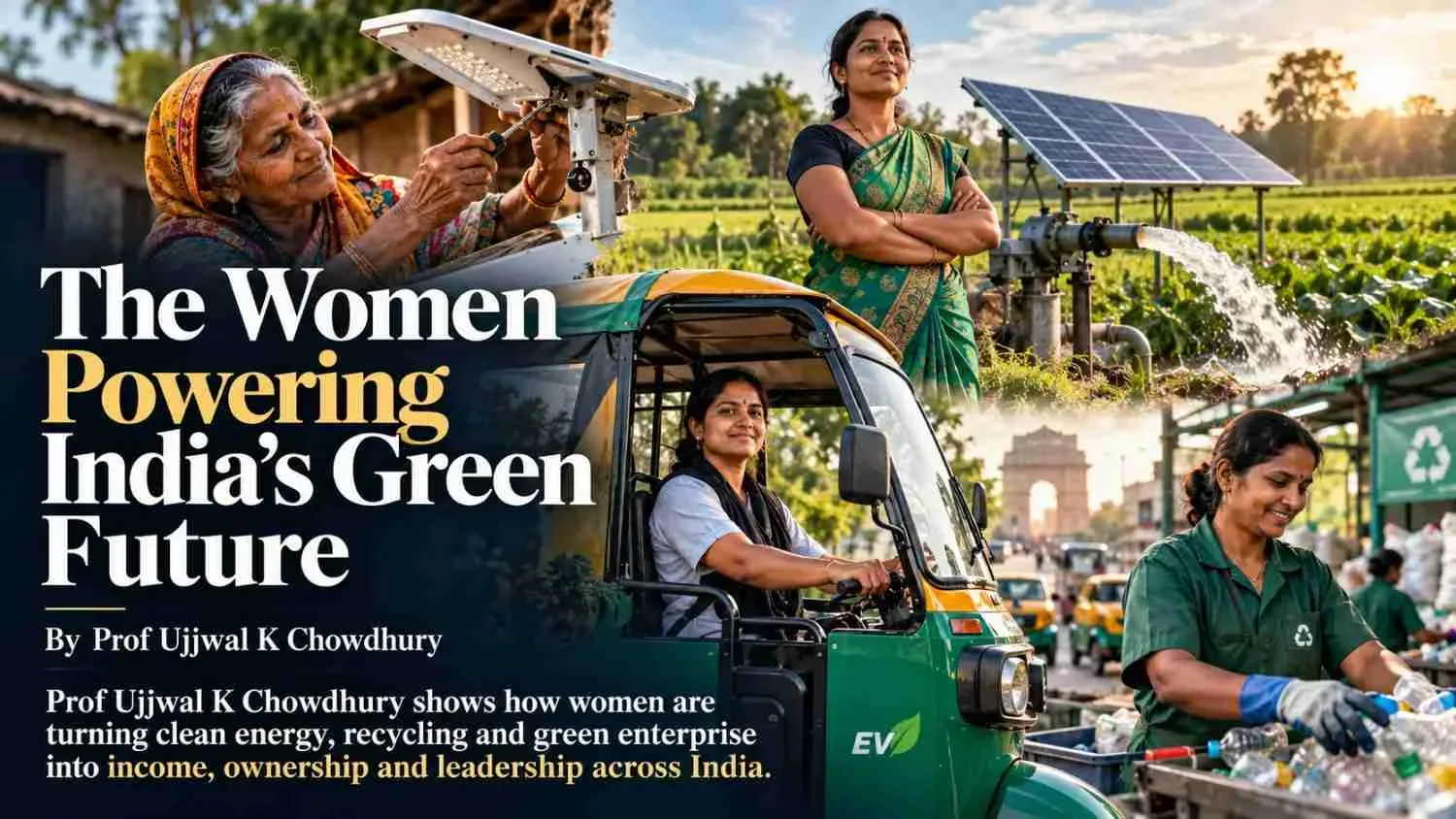
| A grandmother repairing solar lights, a farmer selling sunshine-powered irrigation, a woman driving an electric auto: India’s green transition is changing who gets to handle technology. With the right support, it can also change who earns, owns and leads. |
| Summary: Across India, women are turning cleaner energy, resilient farming, recycling and electric mobility into livelihoods. Their progress is inspiring but uneven. The next breakthrough will depend on practical training, affordable finance, safe workplaces and genuine control over assets and income. |
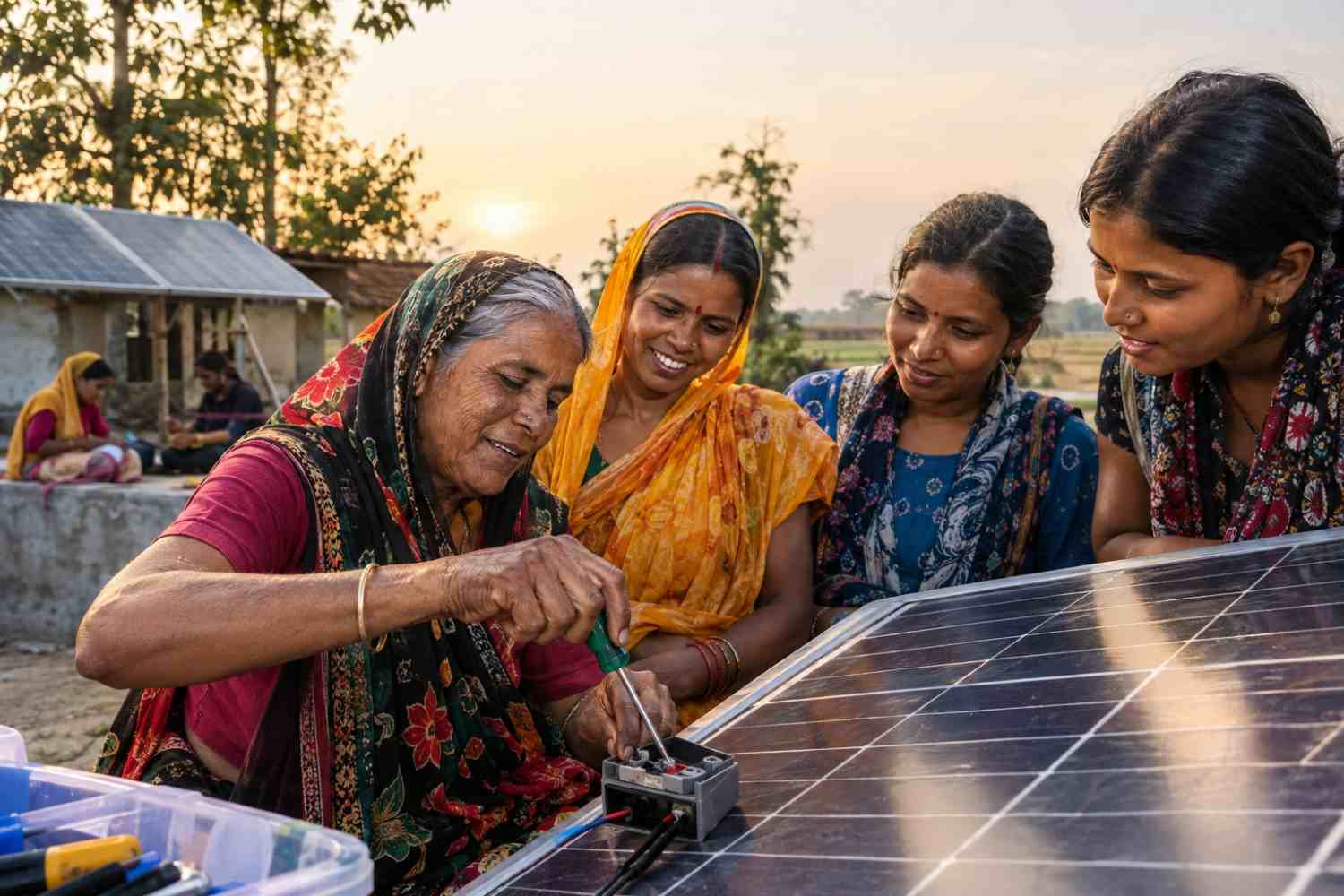
In a village reached by Rajasthan’s Barefoot College programme, the person who fixes your solar light may be a grandmother. She may have spent much of her life being told that technical work belonged to somebody else. Now neighbours depend on her knowledge.
That small change carries a large message.
For generations, women managed the consequences of unreliable energy. They gathered firewood, cooked through smoke, stretched household budgets and arranged children’s homework around power cuts. Yet the people recognised as technicians, engineers and energy decision-makers were usually men.
Across India, that familiar picture is beginning to change. Women are running clean-energy shops, selling irrigation services, assembling electric vehicles and organising urban recycling. Their work offers a hopeful answer to an urgent question: can the country build a cleaner economy while opening better opportunities for women?
The answer is emerging in workshops, farm fields and neighbourhoods, one working business at a time.
The Workshop Door Begins to Open
The older industrial economy concentrated power in large factories, mines, refineries and distant construction sites. Entry often depended on formal qualifications, apprenticeships, mobility and money. Women faced restrictions at almost every step, including the assumption that machines were men’s territory.
Many green technologies offer a different starting point. A solar dryer can serve a small food enterprise. An electric auto can become a family’s productive asset. A community pump can support neighbouring farms. These systems still need serious technical skills, but some can be installed, serviced and managed locally.
The opportunity has grown as India’s clean-energy market has expanded. The National Solar Mission, launched in 2010, helped establish solar power as a national priority. PM Surya Ghar aims to bring rooftop solar to one crore households. PM-KUSUM supports solar energy in agriculture. Every functioning installation creates a need for someone who can explain, fit, finance or repair it.
By 2025, non-fossil sources accounted for half of India’s installed electricity capacity. That describes the equipment available to generate power, rather than half of all electricity produced. Even with that distinction, the expansion marks a substantial market for skills.
Women’s self-help groups provide another advantage: an existing network of trust. A neighbour who has bought from a women-run enterprise knows where to return when something fails.
That relationship matters. Technology becomes useful when people can afford it, understand it and keep it working. Women who know local customers can build businesses around those needs, provided they receive proper training and payment.
Grandmothers With a New Kind of Power
At Barefoot College in Tilonia, Rajasthan, rural women with limited formal schooling have learned to assemble, install and maintain solar lighting systems. Many are older women whose experience had rarely been recognised as a foundation for technical learning.
The teaching approach uses demonstrations, colour codes, repeated practice and learning from other women. It begins with what a learner can understand and do, rather than treating an unfamiliar textbook as the only doorway to competence.
The women known as Solar Mamas have taken these skills into communities in India and across the world. Their example challenges a stubborn habit: confusing limited schooling with limited intelligence.
A local technician also solves a practical problem. A broken light needs somebody nearby who can diagnose the fault and obtain the right component. Equipment distributed with great ceremony can otherwise sit unused for months.
The lesson reaches beyond village lighting. Training institutions can combine accessible teaching with recognised qualifications and demanding safety standards. Women deserve routes into advanced electrical work and engineering as well as entry-level repair.
A grandmother who learns to fix a circuit gives younger girls something powerful to imagine: a future in which their hands belong on the tools.
Bihar’s Energy Shops Sell Confidence Too
In Bihar, Uttam Urja Kendras have brought clean-energy products into women-run shops. The initiative grew through the JEEViKA self-help group network, with technical and institutional support from partners including TERI.
A pilot involving 25 women in five districts in 2021–22 developed into a much larger network. By 2024, 372 women-run marts were reported across 15 districts, with sales of about 50,000 improved cookstoves, alongside solar lights, fans and chargers.
The shopkeeper’s work extends well beyond handing over a box. She demonstrates the product, explains its use, answers doubts and helps customers seek repairs. In places where unfamiliar equipment can inspire understandable suspicion, this is essential business work.
The role also changes how a woman is seen. She becomes the person neighbours approach for advice about energy, product quality and household spending. Technical confidence develops alongside commercial confidence.
This ability comes from experience and learning. Women deserve the same access to tools, technical explanations and business networks that helps any entrepreneur succeed. Their community relationships become an advantage when institutions invest in their expertise.
Maharashtra’s Swayam Shikshan Prayog has similarly supported women entrepreneurs selling cleaner cookstoves, solar lighting and other livelihood technologies.
These enterprises need ordinary business support: reliable stock, working capital, transport, fair margins and dependable suppliers. Inspiration cannot pay an overdue invoice. A women-run energy shop succeeds when its owner can earn enough to keep serving customers and expand her business.
Sunlight Becomes a Business
A solar pump changes more than the fuel used for irrigation. In Bihar’s Solar Didi model, it can turn a woman into the owner of a service that other farmers need.
Programme examples describe women operating five-kilowatt solar systems with pumps and underground pipes, supplying irrigation to around 20–40 neighbouring farmers. Customers pay for the service, creating an income stream from an asset managed locally.
For a farmer, reliable irrigation can mean better control over planting and fewer worries about diesel costs. For the entrepreneur, it brings responsibility for scheduling, pricing, maintenance and accounts.
Ownership makes the difference. If a pump is registered to a woman while somebody else controls the payments and decisions, the photograph tells only half the story.
Finance must therefore reach women who farm without holding land titles. Shared ownership through collectives can help, alongside loans based on service income and group guarantees.
Water needs protection too. Solar energy does not make groundwater unlimited. A successful irrigation business must combine reliable service with sensible water use, so today’s earnings do not undermine tomorrow’s crops.
Larger energy projects also need women’s voices before land is acquired or community resources change. A woman who uses common grazing land may have no title deed, yet her livelihood still matters. Consultation and compensation should recognise that dependence when projects are planned.
Papad Meets the Solar Panel
Some of the most useful green innovations begin with a familiar product.
In Begusarai, Bihar, Mamta Devi and a group of 11 JEEViKA women have used a solar-powered machine to make papad. The technology enters an existing livelihood, helping women improve production rather than asking them to invent an entirely unfamiliar business.
SELCO Foundation’s livelihood work follows a related principle: identify the difficulty first, then choose the energy solution. Women running tailoring units, flour mills or food businesses may need reliable power, efficient equipment or better cooling more urgently than they need a standard solar kit.
A machine that reduces exhausting manual work can free time. A cold-storage system can reduce spoilage. Reliable electricity can help a business complete an order when customers expect it.
But production is only part of the journey. Women also need packaging, food-safety knowledge, bookkeeping and buyers who pay on time. An efficient machine cannot rescue a business with no market.
The same thinking can guide greener textiles and personal-care enterprises. Claims about being “natural” or “eco-friendly” need scrutiny. The useful questions concern energy use, ingredients, packaging, waste and the working conditions of the women making the product.
Smoke Should Never Be the Price of Dinner
For millions of women, the energy transition begins beside the cooking pot.
Smoke, fuel collection and long hours over a stove affect health, comfort and the time available for paid work or rest. Cleaner cooking therefore deserves a central place in any discussion of women and technology.
Pradhan Mantri Ujjwala Yojana, launched in 2016, placed LPG connections in the names of adult women in poor households. By early 2025, connections under the scheme had crossed ten crore.
That expansion matters. Sustained use, however, depends on whether families can afford refills and obtain them reliably. LPG is also a fossil fuel, even though it can provide much cleaner cooking than a traditional smoky chulha.
Biogas, efficient stoves and electric cooking can provide other options where local conditions support them. Each requires attention to cost, maintenance, safety and actual cooking habits. A stove must work for the meals people prepare every day.
Women should help test these systems and be paid to install, explain and repair them. Their experience is valuable product knowledge. Listening to the cook can reveal why an apparently efficient device is awkward to clean, too slow or unsuitable for a household’s utensils.
Adoption begins with that everyday reality.
Millets and Drones Share the Same Field
India’s green future includes both inherited knowledge and new equipment.
In Telangana, women’s sanghams associated with the Deccan Development Society have worked with millet cultivation, community seed banks and farming suited to dry conditions. Their contribution received international recognition through the 2019 Equator Prize.
Keeping a useful seed variety alive is practical climate work. So is understanding soil, conserving moisture and growing a mix of crops that reduces dependence on a single harvest.
The Krishi Sakhi initiative recognises women as trained community resource persons who can spread knowledge of agro-ecological farming, soil management and related practices. Such roles become meaningful livelihoods when advice is valued and paid for.
Namo Drone Didi adds another possibility. Designed to support 15,000 women’s self-help groups with agricultural drones, it opens a route into equipment rental and technical services.
A drone brings responsibilities as well as excitement: safe operation, maintenance, customer scheduling and careful application of farm inputs. Its environmental benefit depends on how it is used. A flying machine alone cannot make farming sustainable.
Women should be able to choose the tools their communities need. A seed bank, a soil test and a drone can all belong in the same agricultural future when each solves a real problem.
A Woman at the Wheel Changes the View
An electric auto driven by a woman challenges two assumptions at once: who belongs in transport and what powers the journey.
In Varanasi, SMV Green Solutions’ Vahini programme has supported women becoming electric-rickshaw owner-drivers through finance, training and operational help. In Bengaluru, a mobility pilot helped Roopa move from homemaking into e-rickshaw driving and mentoring other women.
These are demanding jobs. Drivers must understand routes, customers, charging, repayments and vehicle upkeep. They also need protection from harassment and access to safe rest spaces.
Electric mobility creates opportunities inside factories too. Ola Electric’s Futurefactory in Tamil Nadu has drawn attention for its women manufacturing workforce, demonstrating women’s capacity for precision assembly after suitable training.
The next question concerns advancement. Can an assembler become a supervisor, quality specialist or engineer? Can a driver own another vehicle, train others or build a fleet?
Electric vehicles depend on batteries, electronics, software and diagnostics, creating several routes into technical careers. Women need access to those skills and the promotion opportunities that follow.
The batteries will eventually need safe collection and recycling. Building women’s expertise in these services can create further careers, provided training addresses electrical hazards and material handling. Cleaner transport requires responsible systems throughout a vehicle’s working life.
Policies supporting electric mobility can help by connecting financial assistance with women’s ownership, paid apprenticeships and safe charging infrastructure. A loan and a driving lesson are useful beginnings. A workable daily livelihood requires much more, including manageable repayments and customers who can find the service.
The City Runs on Work It Barely Sees
Long before recycling became fashionable, women waste pickers were recovering materials that cities threw away. Their work saved resources while exposing them to stigma, injury and insecure earnings.
Pune’s SWaCH cooperative has shown how organisation can change that relationship. Emerging from waste workers’ collective action and formalised in partnership with the municipal corporation in 2008, it gives waste pickers an ownership stake in the service they provide.
Thousands of workers, many of them women, collect segregated waste and connect recyclable materials to further use. Their knowledge of neighbourhoods and materials keeps the system functioning.
Kerala’s Haritha Karma Sena offers another example of women’s collectives becoming part of public environmental services through waste collection and recovery networks.
The technical work includes sorting, route planning, record keeping and coordination with households and recyclers. It deserves appropriate equipment, dependable payment and respect.
As recycling becomes more mechanised and profitable, cities should ensure that experienced workers share in the gains. Contracts, insurance, protective equipment and opportunities to manage collection centres or processing units can help.
A cleaner city should also improve the lives of the people whose work makes it clean.
The Roof Is Part of the Climate Fight
Climate technology can be as ordinary as a roof that absorbs less heat.
In Ahmedabad and other cities, Mahila Housing Trust has worked with women in informal settlements on cool roofs, better homes and neighbourhood climate resilience. Women help identify heat risks, understand possible improvements and bring community concerns into public decisions.
Extreme heat makes these interventions urgent. A room that becomes unbearably hot affects sleep, study, cooking and home-based work. Cooling that depends entirely on expensive electricity can be beyond a family’s budget.
Reflective roofs, ventilation and efficient appliances can help where they are appropriately chosen and maintained. Women’s knowledge of when rooms become hottest and how households use them improves the design.
Their participation should also shape heat warnings, drinking-water arrangements and public spaces. A woman managing daily life through a heatwave has information that a distant planning office needs.
The opportunity extends to schools: girls can learn to measure temperatures, understand electricity bills and investigate waste. Practical learning can make climate science familiar while introducing careers in energy audits, building design and environmental services.
A Startup Can Begin in the Dustbin
Green entrepreneurship can begin with a material others have stopped valuing.
Sonal Shukla, co-founder of eConscious, has helped turn plastic waste into furniture. The venture connects collection and recycling with design and manufacturing, showing how a waste problem can become a business opportunity.
Other initiatives widen the field. Kanpur’s flower-waste enterprises have created products such as incense while providing work for women. Eco Femme, established in India in 2010, connects reusable menstrual products with livelihoods and menstrual-health education.
These examples bring sustainability into everyday consumption. They also show why women should have opportunities to develop products and lead enterprises, alongside production jobs.
The financial system needs to recognise that ambition. A founder may have orders, customers and sound accounts while lacking property to offer as collateral. Finance based on business income, purchase orders or suitable guarantees can help her expand.
Larger companies can contribute by buying from women-led suppliers and paying promptly. Procurement can provide the stable demand that a small enterprise needs to invest in better equipment and employ more people.
The Numbers Interrupt the Applause
These stories deserve attention. They should also make us ask how widely the opportunities extend.
A 2026 industry survey put women at about 11 per cent of the workforce across India’s surveyed solar and wind deployment and manufacturing businesses. Rooftop solar performed somewhat better, at about 15 per cent. Around 62 per cent of the women employed were in non-technical roles such as administration, accounting and human resources.
These findings describe an opening that remains uneven. Women’s participation in visible projects has not yet translated into equal access to technical work or leadership.
The obstacles are familiar. Training may require travel that a woman cannot safely undertake. A factory may offer no childcare or dependable transport. A bank may demand a land title she does not hold. Family members may claim the earnings from a business registered in her name.
Women facing caste discrimination, poverty or disability can encounter additional barriers. Programmes need to respond to their circumstances rather than assuming that every applicant starts with the same resources.
Technology will not solve these problems by itself. Their persistence gives employers, governments and communities specific work to do.
A Certificate Needs a Paycheque
South Asia offers a warning. A follow-up of an earlier women’s renewable-energy training programme linked to Grameen Shakti in Bangladesh found that only about three per cent of those trained had been employed by the organisation. Training had outpaced the routes into work.
India can learn from that experience. Every publicly supported course should connect to paid apprenticeships, jobs, service contracts or a credible enterprise opportunity. Success should be measured after women leave the classroom.
Practical courses need local-language teaching, tools, troubleshooting and recognised qualifications. Women should be able to progress into battery diagnostics, solar design, electrical safety, energy audits and advanced manufacturing.
Support must extend beyond the syllabus. Childcare, safe transport and predictable schedules help women remain in training and employment. At home, sharing care and domestic work can make a technical career possible.
Mentors can help graduates negotiate their first contract, resolve a difficult repair and seek promotion. Continued support makes early setbacks easier to overcome while women establish their careers.
Public schemes already create markets. Rooftop programmes can support women-led maintenance firms. Agricultural schemes can finance collectively owned equipment. Municipalities can buy services from women’s cooperatives. CSR funding can help pay for tools and apprenticeships, with employment outcomes tracked beyond the launch event.
The future also includes green hydrogen, battery research and sophisticated energy systems. Girls entering school today should see routes into those laboratories and control rooms. Women building businesses now should have the finance and contracts to grow with the market.
A grandmother repairing solar lights has already shown what accessible learning can achieve. The next task is to make that opportunity ordinary: a woman with the skills to do the work, the resources to own the equipment and the authority to decide where her enterprise goes next on her terms.
Prof Ujjwal K Chowdhury
Educator & Author
Vice President, Global Media Education Council
| Hashtags: #GreenTechnology #WomenInGreenTech #GenderJustice #WomenEntrepreneurs #CleanEnergy #SustainableIndia #GreenJobs |


Add a Comment