
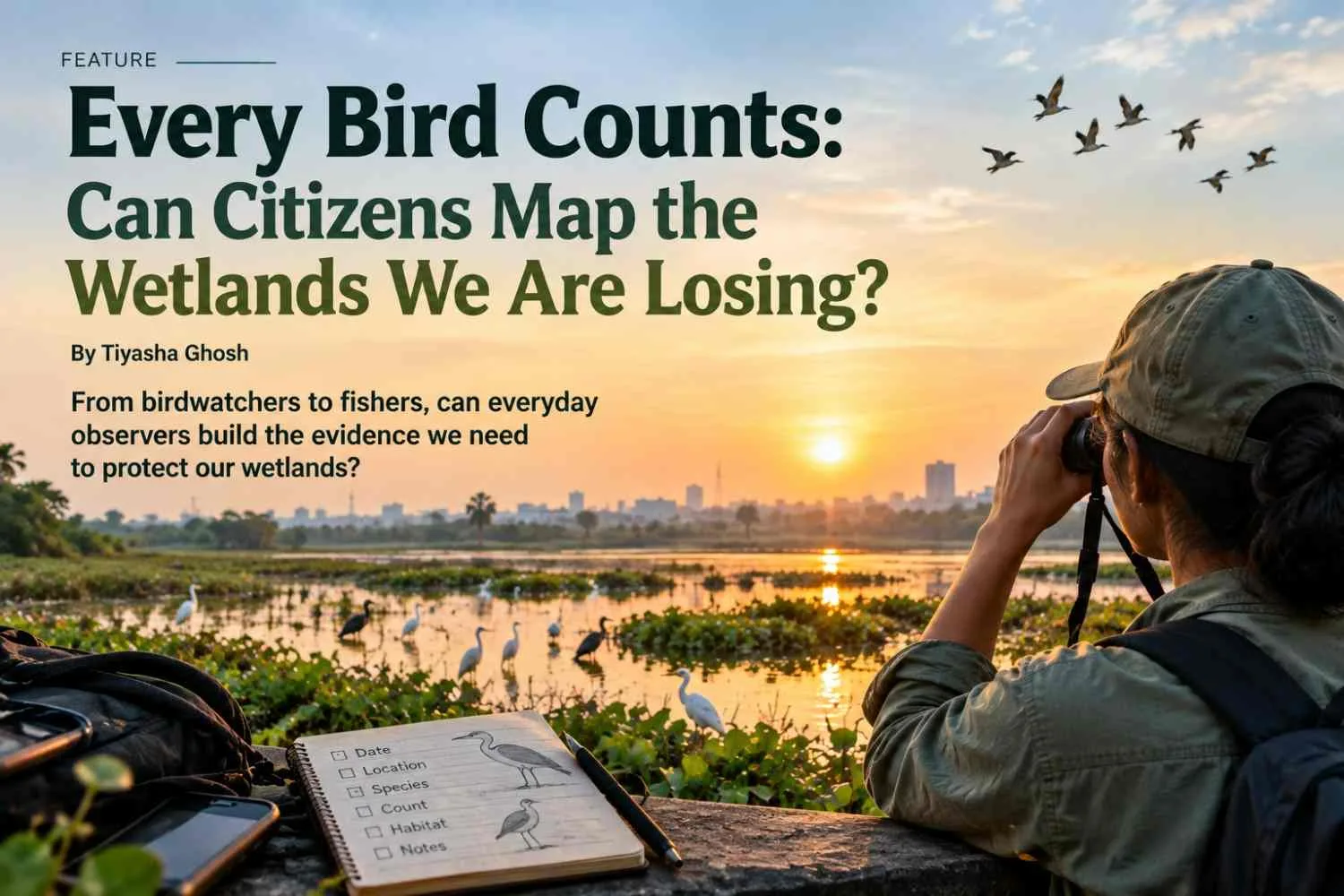
9 October 2026 | Kolkata
| Can ordinary bird observations become reliable evidence of ecological change in Kolkata's wetlands? |
Summary East Kolkata Wetlands is not simply a birding destination. Its wetlands, sewage-fed fisheries, agricultural plots and surrounding communities form a working ecological system that supports livelihoods, treats wastewater and provides important habitat for waterbirds. World Migratory Bird Day 2026 places citizen science at the centre of bird conservation with the theme “Every Bird Counts – Your Observations Matter!” The question for Kolkata is more practical: can repeated observations by birders, fishers, residents and researchers become a reliable local evidence system for tracking changes in wetland health? The answer depends not on how many photographs are uploaded, but on whether observations are made consistently, verified properly and connected to habitat conditions. |
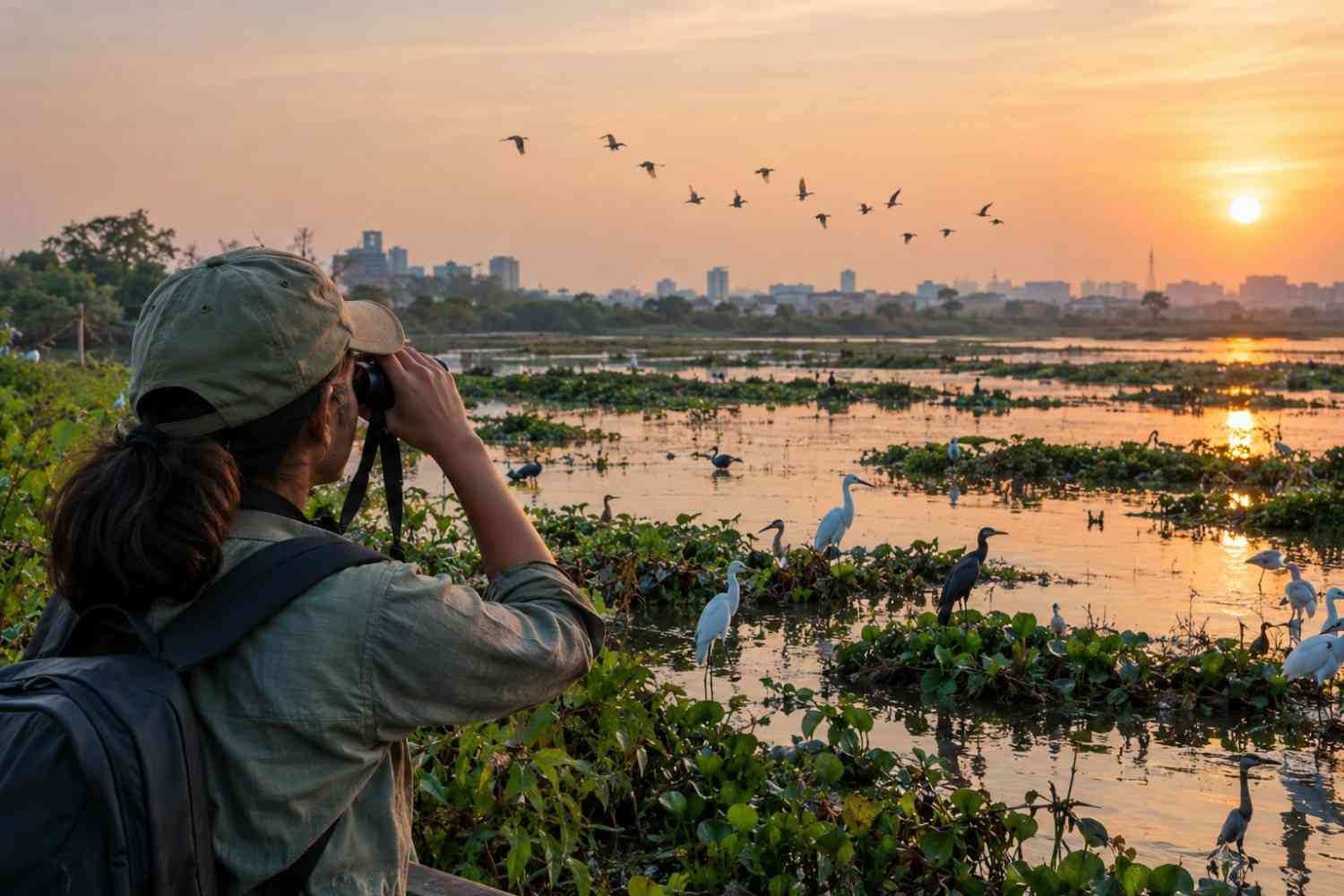
Can citizens turn birdwatching into evidence of a wetland under pressure?
A single sighting is interesting.
A year of comparable sightings can become evidence.
That distinction matters.
The East Kolkata Wetlands Management Authority's management plan already recommends coordinated monitoring of waterbirds at major congregation sites, including mid-winter counts using Asian Waterbird Census protocols. It also calls for information on habitat structure, seasonal abundance and changes in prey so that population estimates and trends can inform management.
The challenge, therefore, is not to invent citizen science.
It is to make existing public observation more systematic, repeatable and useful.
EAST KOLKATA'S BIRDS ARE PART OF A MUCH LARGER SYSTEM
The East Kolkata Wetlands cover about 12,500 hectares and include nearly 254 sewage-fed fisheries across 37 mouzas, alongside agricultural areas and other land uses.
That makes the wetlands unusual. Their ecological value is tied directly to human activity.
Wastewater supports fish production. Wetland processes support agriculture. Open water and vegetation provide habitat. The landscape also contributes to flood buffering.
Birds sit inside this system.
They respond to water availability, vegetation, food, disturbance and changes in habitat. That makes them potentially useful ecological indicators.
But a bird count alone cannot explain why numbers change.
A lower count could mean fewer birds.
It could also mean a different survey time, poorer visibility, disturbance, altered water levels or a change in where birds are feeding.
That is why the method matters as much as the number.
THE DATA ALREADY CARRIES A WARNING
The EKW management plan records 267 bird species documented since 1964, including 93 waterbird species, of which 36 were identified as migratory.
But historical records also show a changing picture.
The management plan notes that while 248 species were recorded during an early Zoological Survey of India survey between 1964 and 1969, only 162 species had been variably recorded during the following decades. It also identifies species that had not been recorded after earlier surveys.
These historical comparisons should not automatically be treated as proof of local extinction. Survey effort, habitat and recording practices changed over time.
But they do establish something important:
there is enough historical variation to justify better monitoring.
The question is whether today's observations can be structured well enough to create a dependable baseline for tomorrow.
WHAT SHOULD A CITIZEN COUNT?
Not just birds.
A useful monthly observation should record:
- date and time;
- location or designated survey zone;
- species observed;
- number of individuals;
- duration of observation;
- approximate distance or route covered;
- habitat type;
- visible disturbance;
- photographs or audio where possible.
This is the difference between a sighting and a dataset.
A photograph uploaded with no location, time or effort information may be useful for identification.
A standardised observation repeated at the same site every month can reveal something much more valuable: change.
FROM SIGHTING TO DATASET
Observation → Date + Time → Location → Effort → Species → Count → Habitat → Disturbance → Verification → Monthly trend
A simple visual explaining why standardised observations are more valuable than isolated bird photographs.
ONE BIRD COUNT IS A SIGHTING. TWELVE ARE A DATASET.
This is where citizen science becomes analytically useful.
Suppose a group records birds at the same wetland zone every month for a year.
The project can begin asking better questions:
Are winter migrants arriving at roughly the same time?
Are particular species becoming less frequent?
Are bird numbers changing with water levels?
Does disturbance correspond with changes in observations?
Are certain habitat zones consistently richer than others?
The point is not to force a conclusion from the first few months.
It is to build a time series.
World Migratory Bird Day's 2026 campaign explicitly highlights community science because repeated observations from large numbers of people can contribute to understanding migration, population trends and important habitats. The International Waterbird Census, which marks its 60th anniversary in 2026, demonstrates the value of long-running volunteer-based monitoring.
AND THE FISHERS MUST BE PART OF THE COUNT
There is another reason not to make this a project only for birders.
East Kolkata Wetlands are working wetlands.
Fishers, farmers and other local users experience changes in water, vegetation, fish availability, access and disturbance directly.
A birder may record fewer birds at a pond.
A fisher may know that the water level changed, vegetation was cleared or fish availability shifted.
Neither observation should automatically replace the other.
They should be read together.
This is particularly important because the wetlands' ecological value is inseparable from the livelihoods built around them.
A citizen-monitoring project that treats local communities merely as subjects of observation would reproduce the very gap it is trying to close.
THE COMPETING VIEW: CAN CITIZEN COUNTS REALLY BE TRUSTED?
Yes — but only within limits.
Citizen observations can be powerful because they generate information across large areas and over long periods.
But they can also contain identification errors, duplicate observations and inconsistent effort.
One experienced birder may identify a species confidently.
A first-time observer may not.
One survey may last 90 minutes.
Another may last ten.
One observer may systematically cover open water.
Another may remain near the road.
These differences can distort comparisons.
The solution is not to exclude citizens.
It is to standardise participation.
Training, fixed survey zones, clear protocols, moderation and uncertainty labels can turn public participation into usable evidence.
That is also why the proposed project should not claim that every observation is automatically verified.
A SECOND WETLAND PROVIDES THE COMPARISON
East Kolkata Wetlands should not be studied in isolation.
A second eastern-India wetland can provide a comparative lens. Chilika Lagoon in Odisha is particularly useful because its authorities maintain formal biodiversity and bird-monitoring systems and completed a 2026 bird estimation exercise.
Official Chilika information reports a 2026 bird count of about 1.13 million birds, reinforcing the lagoon's importance as a major wintering habitat.
The purpose of comparison is not to rank Kolkata against Chilika.
It is to ask a more useful question:
What does good wetland monitoring look like when it is repeated at scale?
Different wetlands have different ecological systems, so raw bird numbers should never be compared without accounting for habitat, area, survey effort and species composition.
WHY THE MONTHLY COUNT SHOULD MEASURE HABITAT TOO
A bird-counting project can fail if it records birds but ignores the landscape around them.
Every monthly count should therefore include a short habitat checklist:
Water: high / normal / low
Vegetation: intact / changed / cleared
Human disturbance: low / moderate / high
Fishing activity: low / moderate / high
Construction or land-use change: observed / not observed
Pollution indicators: observed / not observed
Birding pressure: low / moderate / high
This does not turn citizens into hydrologists or ecologists.
It simply creates context.
If bird numbers change, the dataset may then offer clues about what else changed at the same location.
THE MONTHLY WETLAND SCORECARD
A simple dashboard showing:
Bird count | Migratory species | Water level | Habitat condition | Disturbance | Pollution observations
The visual should clearly state: “Citizen observations — not independently verified scientific measurements.”
THE PROJECT NEEDS MODERATION, NOT JUST PARTICIPATION
The easiest mistake would be to create another online form that accumulates thousands of photographs but produces little usable information.
A serious citizen-monitoring programme needs an editorial protocol.
Every observation should be classified as:
Verified / Probable / Uncertain / Rejected
Sensitive information must also be protected.
Exact nesting locations or locations of threatened species should not be publicly disclosed if publication could increase disturbance or exploitation.
The project should also distinguish between:
what was observed, what was reported, what was verified and what is inferred.
That distinction is essential if the resulting dataset is ever used in policy discussions.
WHAT WOULD MAKE THE DATA GENUINELY USEFUL?
Five conditions would make the project considerably stronger.
1. Consistency
The same sites should be monitored using comparable effort.
2. Continuity
The project should run monthly rather than only around World Migratory Bird Day.
3. Verification
Uncertain records should be reviewed rather than silently accepted.
4. Context
Bird observations should be accompanied by basic habitat and disturbance information.
5. Transparency
The public should be able to understand how the data was collected and what its limitations are.
The East Kolkata Wetlands management plan already provides a useful institutional foundation by recommending coordinated waterbird monitoring, participant training and collection of habitat and seasonal abundance information.
The citizen project can build on that framework rather than operate separately from it.
THE DOCUMENTARY EVIDENCE MUST SIT BEHIND THE BIRDS
The strongest story will not come from photographs alone.
The reporting file should seek:
- dated citizen observations;
- survey effort and route information;
- historical bird records;
- Asian Waterbird Census data where available;
- EKWMA monitoring records;
- current satellite imagery where land-use change is being examined;
- habitat observations;
- water-quality information where relevant;
- notices or official records relating to wetland management;
- interviews with birders and wetland users;
- responses from EKWMA and relevant government authorities.
The evidence should then be compared.
If citizens report fewer birds at a location, the next question should be:
What else changed there?
That is where the story moves from birdwatching to environmental journalism.
THE EVIDENCE CHAIN
Citizen observation → Verification → Habitat context → Historical comparison → Authority records → Independent analysis → Conservation action
The visual should make clear that a citizen observation is the starting point, not automatically the final conclusion.
WHAT SHOULD AUTHORITIES BE ASKED?
A citizen-monitoring programme should ultimately lead to institutional questions.
For example:
Does EKWMA have a current baseline for waterbird populations across major wetland zones?
How frequently are bird populations formally monitored?
Are citizen observations incorporated into management decisions?
Which wetland habitats are showing measurable change?
How are disturbance and land-use changes being recorded?
What information is publicly available?
These questions turn a public activity into an accountability mechanism.
THE REAL QUESTION IS NOT WHETHER CITIZENS CAN COUNT BIRDS
They clearly can.
The harder question is whether institutions, researchers and communities can build a system in which those observations become credible evidence over time.
That requires more than enthusiasm.
It requires methodology.
It requires moderation.
It requires data continuity.
And it requires authorities to actually use the information once it exists.
The 2026 World Migratory Bird Day campaign is built around precisely this principle: observations become valuable when they contribute to the knowledge required for conservation. (CMS)
For East Kolkata Wetlands, that principle could be tested locally.
A birder with binoculars.
A fisher watching a familiar pond.
A student recording birds from the edge of a wetland.
A researcher checking the trend.
An authority responding to the evidence.
That is how a collection of observations becomes an environmental record.
THE FIRST COUNT SHOULD NOT BE THE LAST
World Migratory Bird Day can generate attention for a day.
The real opportunity is to use that attention to establish a monthly monitoring habit.
The first count can provide a baseline.
The second can provide comparison.
The sixth can begin showing a pattern.
The twelfth can start answering questions.
And after several years, the dataset may tell us something that photographs alone cannot:
how the wetland is changing.
That is ultimately the test.
Not how many people participated.
Not how many photographs were uploaded.
Not how many species were listed once.
But whether repeated observations can reveal ecological change early enough for communities and institutions to act.
Every bird counts. But every observation must count for something.
READER ACTION: MONTHLY WETLAND BIRD COUNT
Record:
- Date and time
- Wetland / survey zone
- Species
- Number of birds
- Observation duration
- Habitat condition
- Disturbance
- Photo/audio evidence
Do not publish exact nesting locations or sensitive threatened-species coordinates.
Uncertain observations should be labelled as uncertain rather than presented as verified records.
The proposed series can begin around World Migratory Bird Day and continue as a monthly, moderated citizen-science initiative.
SOURCES
- World Migratory Bird Day 2026 — Official campaign
https://www.worldmigratorybirdday.org/ (worldmigratorybirdday.org) - Convention on Migratory Species — World Migratory Bird Day 2026
https://www.cms.int/news/2026017-world-migratory-bird-day-2026-10-october-2026 (CMS) - WMBD 2026 Campaign Toolkit
https://www.worldmigratorybirdday.org/assets/files/WMBD_2026_Campaign_Toolkit_en.pdf (worldmigratorybirdday.org) - East Kolkata Wetlands Management Authority
https://ekwma.wb.gov.in/ - East Kolkata Wetlands Integrated Management Plan 2021–2026
https://ekwma.in/ek/wp-content/uploads/2021/08/Integrated-Management-Plan-of-East-Kolkata-Wetlands-2021-2026.pdf - Ramsar — East Calcutta Wetlands
https://www.ramsar.org/ - Chilika Development Authority — Ecology & Biodiversity
https://www.chilika.com/chilika-ecology-and-biodiversity.php - Nature Environment & Wildlife Society — Bird Meet 2026
https://naturewildlife.org/event/ - eBird Science — Data and Methodology
https://science.ebird.org/






Add a Comment