September 25, 2026 | Kolkata
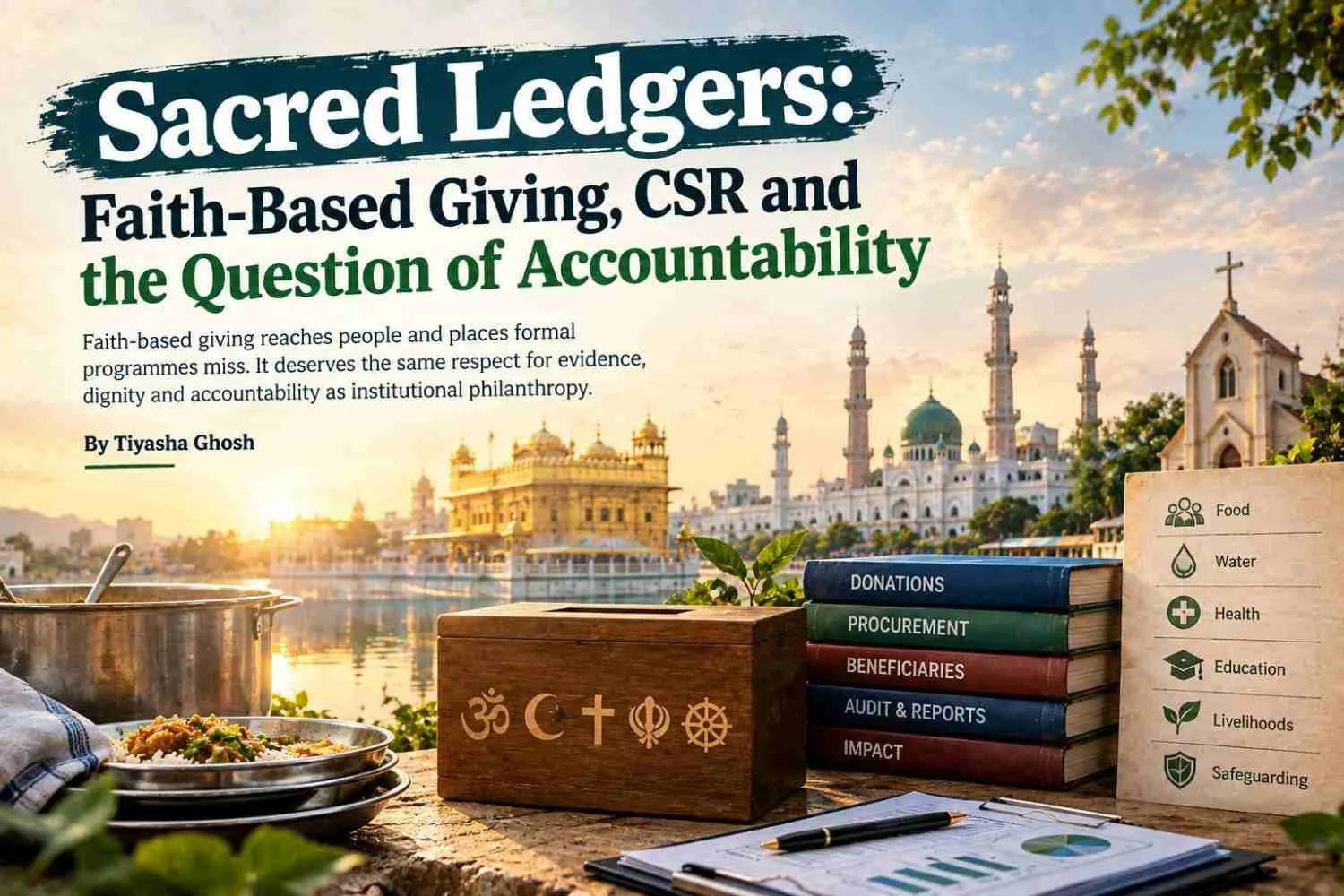
| Faith-based giving often reaches people long before a formal programme does. From langars and annaprasadam to zakat, daan and church-led welfare, millions of rupees, meals, medicines, education and volunteer hours move through religious and community institutions. But when giving becomes a large social-service system, devotion alone cannot be the only ledger that matters. The real test is whether money, food, labour and care can be traced to outcomes - with dignity, safety, consent and accountability intact. |
Summary India's faith-based giving ecosystem is enormous, diverse and difficult to measure as one sector because zakat, daan, seva and religious charity operate according to different traditions and institutional structures. Current documentary evidence shows everything from Tirumala's large-scale free-food system and the Golden Temple's langar to structured zakat programmes funding education, livelihoods and food relief. At the same time, India's formal CSR system reported about ₹40,794 crore in expenditure in FY2024-25, with detailed disclosure requirements that make corporate giving comparatively easier to track. (Corporate Data Management Portal) The question is not whether faith-based giving is charitable enough; it is whether institutions handling public-facing welfare can make their finances, procurement, beneficiary selection, safeguards and outcomes visible enough to earn durable trust. The strongest models suggest that faith and accountability do not have to compete. They can reinforce each other when the sacred act of giving is matched by a secular discipline of evidence. |
Can Faith-Based Giving Reach the Last Mile Without Losing Accountability Along the Way?
There is an old Indian habit of giving before asking for a receipt.
A handful of rice placed in a temple collection, money dropped into a mosque’s charity box, a contribution to a gurdwara kitchen, food distributed through a church, a daan to a community trust, or a few hours of seva may never be described as philanthropy.
But added together, these everyday acts of giving can form substantial systems of welfare.
They feed people. They support students. They help pay medical bills. They provide water. They keep community kitchens running. They support families through crises. And because they are rooted in local communities, they can often mobilise people, food and resources faster than formal programmes.
That reach is part of their strength.
But it also raises a question that is neither cynical nor anti-faith. It is a question of stewardship.
What happens to the giving after it leaves the donor’s hand?
Who receives it?
Who decides where it goes?
How much reaches the person it was meant to help?
And what systems exist to ensure that trust is not misplaced?
These questions do not diminish the act of giving. They recognise the responsibility that comes with it.
Faith-based giving is built on trust. But when that trust becomes a large and recurring flow of money, food, property, volunteer time or other resources, accountability becomes part of protecting the very purpose behind the giving.
The question is not whether faith should give. It is whether every act of giving can travel the last mile with its purpose, dignity and impact intact.
Why Can’t Faith-Based Giving Be Measured Like CSR?
Before asking how faith-based giving should be measured, it is important to understand what is actually being given and why.
The language of giving itself reveals why a simple comparison with corporate philanthropy does not work.
Zakat is an Islamic obligation governed by defined religious principles concerning eligible giving and recipients. Daan in Hindu traditions can refer to voluntary giving shaped by religious, ethical and social ideas. Seva in Sikh practice centres on selfless service and participation, rather than simply transferring money or resources from one person to another.
These are not interchangeable versions of CSR.
A langar, for instance, is not simply a corporate food-distribution programme with a religious identity attached to it. The principle of seva shapes the entire relationship between giving and receiving. At the Golden Temple, people from different backgrounds sit together and share the same meal, while volunteers participate in cooking, serving and cleaning.
The value lies not only in how much food is distributed, but also in the system of participation, equality and service through which it is provided.
That distinction matters when accountability enters the conversation.
Transparency should not flatten the cultural or religious meaning of the institution being examined. A reporting framework that treats every form of giving as a financial transaction risks measuring the activity while missing its purpose.
The question, therefore, is not:
Can faith be converted into a corporate reporting template?
It is a more useful one:
Can faith-based institutions preserve the traditions that give their work meaning while making the public consequences of that giving transparent and verifiable?
That is where accountability and cultural integrity have to meet.
When Giving Becomes an Institution, Does Accountability Change?
Faith-based giving is already operating at a scale far beyond the occasional donation.
Consider Tirumala Tirupati Devasthanams (TTD). Its approved 2026–27 budget stands at ₹5,456.26 crore, including ₹118.89 crore for its educational institutions. The board has also approved a new Annaprasadam complex and modern kitchen, with Reliance Industries proposing a ₹100–120 crore donation towards the project. (Source: TTD News)
The scale of its food operation is equally significant.
TTD’s official Annaprasadam information lists capacity of roughly 1.59 lakh meals on weekdays and 2.05 lakh on weekends across its various locations, with substantially higher service during major occasions. The system also involves the daily consumption of large quantities of rice, vegetables and milk, alongside donation-based supplies. (Source: Tirumala Tirupati Devasthanams)
Donations continue to flow into the system. In April 2026, ₹44 lakh was donated for a day’s Annaprasadam distribution. In May, an anonymous devotee donated more than ₹1 crore, while in July, the trust reported receiving another ₹60.61 lakh from several donors. (Source: TTD News)
At this scale, the question is no longer simply whether devotees are giving.
It is about how a large food-and-service institution manages what they give.
That brings procurement, storage, food safety, wastage, maintenance, donor restrictions and beneficiary access into the conversation.
Once giving becomes a system, stewardship has to become a system too.
The Langar Economy Shows What Seva Looks Like at Scale
The same shift can be seen at Amritsar’s Golden Temple.
A June 2026 report by The Indian Express described the Guru Ramdas Langar as feeding more than 1.2 lakh devotees every day during the summer peak.
The infrastructure required to sustain that service is enormous. During an LPG supply disruption in March 2026, The Times of India reported that the kitchen was using around 25 LPG cylinders and 1,200 units of piped gas every day, while maintaining a reserve of more than 500 quintals of firewood.
These figures reveal something important about seva.
Service has infrastructure.
There are kitchens, procurement systems, fuel supplies, storage facilities, transportation, cleaning operations, workers and volunteers. There are also food-safety responsibilities and costs that exist regardless of whether the service is described as charity, devotion or seva.
The financial scale is substantial as well. According to the SGPC, as reported by The Tribune, offerings and donations at Sikh shrines under its control totalled around ₹632 crore during FY2025–26. The SGPC has also said it has mechanisms for managing daily cash offerings and donations.
So the accountability question moves beyond:
“Are people being fed?”
It becomes:
How is the food procured? How much is donated in kind? How much is spent? How much is wasted? What controls exist over cash? Who audits the system? And what happens when something goes wrong?
The purpose is not to turn langar into a corporate operation.
It is to recognise that an institution built on service still has an obligation to protect the people it serves and the trust that sustains it.
Zakat Adds Another Question: Does Giving Relieve Poverty or Reduce It?
The zakat ecosystem brings another dimension into the discussion: what happens after immediate relief?
The Association of Muslim Professionals’ AMP Zakat Fund reported that in 2025 it disbursed ₹2.64 crore to 4,491 beneficiaries. Its published allocation included approximately ₹98 lakh for higher education, ₹61 lakh for self-employment, ₹67 lakh for basic education, ₹31 lakh for food relief and ₹8 lakh for ulema support.
The fund reported assistance to 552 higher-education students, 223 self-employment beneficiaries and 3,091 families through food support. (Source: AMP Zakat Fund Impact Report 2025)
The model illustrates why the outcome of giving can matter as much as the amount distributed.
Food can prevent hunger today.
A scholarship can influence a student’s next decade.
A livelihood grant can reduce repeated dependence.
That changes the accountability question.
It is no longer enough to report:
“₹2.64 crore distributed.”
A stronger account asks:
1. How many people applied?
2. What determined eligibility?
3. How many applications were accepted or rejected?
4. How much reached each beneficiary?
5. How much went towards administration?
6. How many students continued their education?
7. How many livelihood beneficiaries remained economically active?
8. How much food support was one-time and how much was recurring?
In March 2026, The Indian Express reported estimates of Indian zakat collections during Ramadan ranging from ₹10,000 crore to ₹40,000 crore, while also making clear that these were estimates rather than an official national accounting.
The enormous range itself reveals the problem.
India has a vast culture of giving. It does not yet have a single reliable national ledger for faith-based giving.
What Can Formal Charities Teach Without Replacing Faith?
Christian charitable organisations offer another useful example: faith-based motivation can coexist with formal documentation.
Operation Barnabas, a registered Christian charitable trust, published an audited 2024–25 report covering medical assistance, education and social welfare. It reported helping 255 families with ₹1.36 crore in medical aid during the year and nearly 6,500 medical claims reimbursed since the programme began.
Its annual report also includes an independent auditors’ report and a statement concerning the utilisation of foreign contributions under FCRA. (Source: Operation Barnabas Annual Report 2024–25)
This does not automatically prove that every programme was effective.
An audit can establish that financial records exist. It cannot, by itself, prove that every intervention achieved its intended social outcome.
But it creates something important:
a documentary trail that another party can examine.
That is the difference between trust as belief and trust as governance.
Good accountability does not ask donors to stop trusting.
It gives them more reasons to trust.
So, How Different Is Faith-Based Giving From CSR?
The two systems are fundamentally different, but they increasingly intersect.
India’s CSR framework is statutory. Companies covered by Section 135 of the Companies Act operate within a defined framework, with CSR expenditure reported through the Ministry of Corporate Affairs.
The government has reported that companies filed more than ₹1.44 lakh crore in CSR expenditure between FY2019–20 and FY2023–24. MCA data also records approximately ₹40,794 crore in disclosed CSR expenditure for FY2024–25. (Source: Ministry of Corporate Affairs / Press Information Bureau)
CSR comes with formal mechanisms including annual action plans, board oversight, disclosures, CFO certification and, for qualifying projects, independent impact assessment.
Faith-based giving does not operate under one equivalent national framework.
Religious and charitable trusts can receive voluntary contributions and obtain tax benefits under applicable provisions, subject to statutory conditions. Registered trusts can also face audit and reporting requirements, including Form 10B where applicable.
Foreign contributions are governed separately under FCRA, which requires the relevant registration or prior permission and imposes reporting and compliance requirements.
There is another distinction that needs to remain clear:
CSR money cannot simply become religious expenditure because a religious institution is willing to receive it.
CSR spending must relate to activities permitted under Schedule VII. These include areas such as hunger, healthcare, sanitation, safe drinking water, education, livelihoods, environmental sustainability and rural development.
A temple, mosque, church or gurdwara can therefore potentially participate in a CSR project when the project itself satisfies the CSR framework.
Religious identity alone does not make an activity CSR-eligible.
That distinction protects both systems.
The Real Accountability Test Begins After the Donation
The entire question can be reduced to one chain:
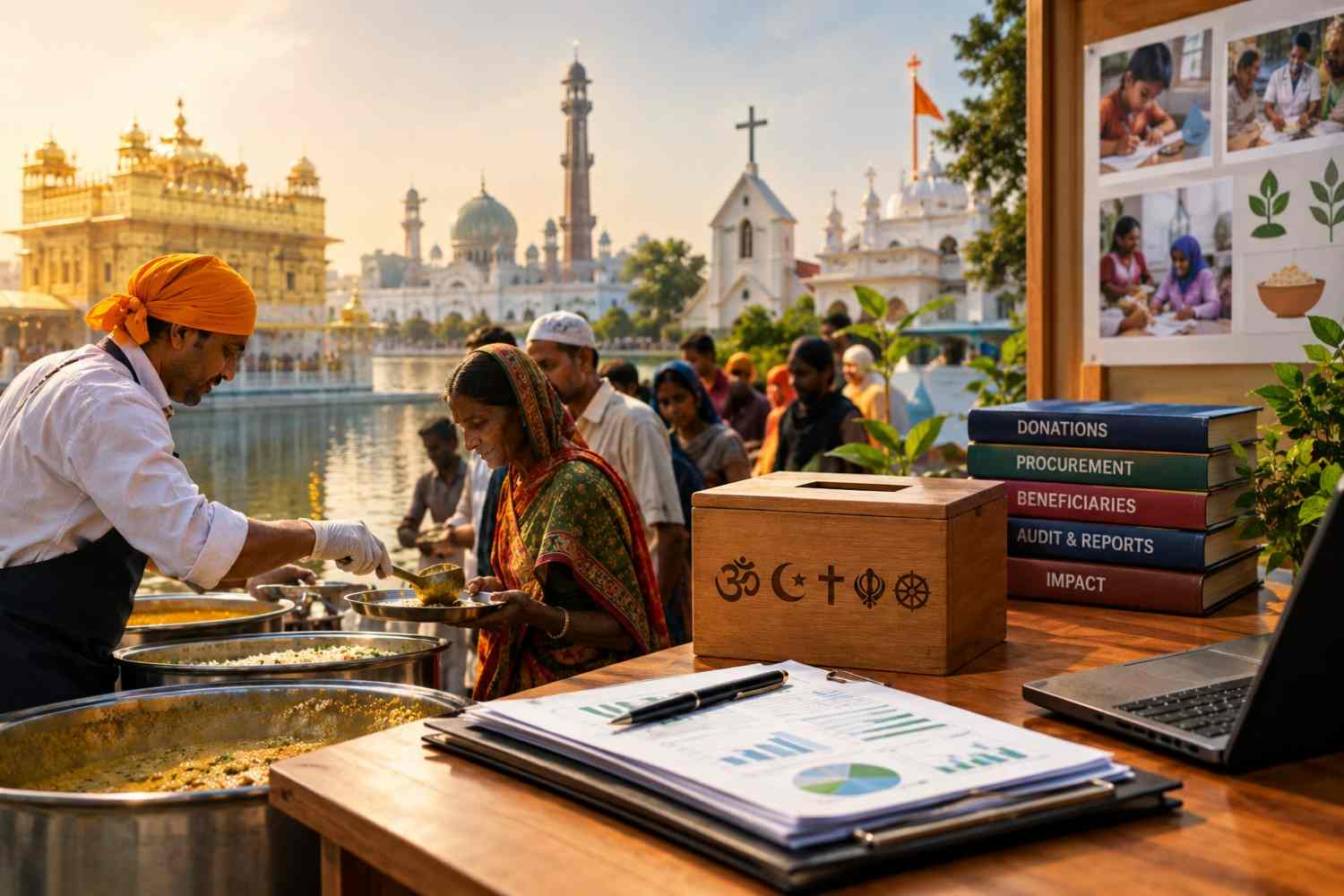
Donation → Allocation → Procurement → Delivery → Beneficiary → Outcome → Maintenance
If the chain breaks at any point, accountability becomes weaker.
A food programme should therefore report more than the number of meals served. It should be able to demonstrate appropriate procurement, food safety, storage, wastage management and maintenance.
A water project should establish the baseline, number of users, water quality, operating costs and responsibility for maintenance.
A scholarship should disclose eligibility criteria, number of recipients, amount per recipient and continuation.
A medical programme should track patients, treatment completed, referral outcomes and safeguarding.
A livelihood programme should ask the harder question:
Did the intervention actually change income or economic stability?
And a volunteer programme should distinguish between hours contributed and social value created.
This is where formal philanthropy has something useful to offer faith-based institutions.
Not because corporate systems are perfect.
They are not.
But because measurement forces an organisation to confront the gap between activity and outcome.
Can Accountability Protect Dignity Too?
There is another ledger that cannot be reduced to rupees.
A person receiving food is not a photograph.
A child receiving a scholarship is not a CSR success story.
A patient receiving treatment is not an impact statistic.
A woman receiving livelihood support is not a donor testimonial.
Faith-based institutions can have an important advantage here. Their traditions of service can challenge the hierarchy between giver and receiver. The principle of langar, for example, brings people together rather than creating a visible divide between those who give and those who receive.
But moral authority can also create a different risk.
When an institution is deeply trusted, beneficiaries, volunteers or staff may find it difficult to question decisions or report wrongdoing.
That makes safeguarding and grievance mechanisms essential.
A credible institution should provide a way for someone with less power to say:
The food was unsafe.
The money did not arrive.
The selection process was unfair.
The volunteer abused his position.
The promised service stopped.
My personal information was misused.
Accountability becomes meaningful only when the person receiving the service has a way to challenge the person providing it.
A Sacred Kitchen Still Needs Food Safety
Food safety does not become optional because food is sacred.
India’s food regulator has recognised this through FSSAI’s Eat Right Place of Worship initiative, which encourages religious institutions handling prasad, langar and other food to adopt food-safety and hygiene practices. The certification process includes registration or licensing, audits and training.
FSSAI’s BHOG guidance was also developed specifically to improve food safety at places of worship and address food served as prasad and langar.
The principle is simple.
A meal given freely can still make someone sick.
A sacred kitchen still needs clean water.
A volunteer still needs training.
A large food operation still needs traceability.
And a beneficiary still has the right to safety.
Faith can determine why the food is served. It cannot remove the responsibility to ensure that the food is safe.
Where Does the Debate Actually Stand?
There are at least three legitimate positions.
The faith-first view argues that imposing corporate-style measurement on seva, daan or zakat can misunderstand the purpose of giving. Much of this work is sustained by trust, volunteerism and spiritual obligation rather than managerial targets. Excessive paperwork could also divert resources away from actual service.
That concern deserves to be taken seriously.
The accountability-first view starts from a different premise: once an institution manages significant donations and provides essential services, donors and beneficiaries have a legitimate interest in knowing where resources go. Transparency can protect institutions from misuse, waste and reputational damage.
Then there is a bridge position.
The goal does not have to be making religious giving imitate CSR.
It can be establishing a minimum public-interest evidence standard.
Different faiths can retain different definitions of giving.
Their accountability can still share common questions:
How much came in?
Where did it go?
Who received it?
What was actually delivered?
Was it safe?
Was consent respected?
What changed?
Who maintains it now?
What Should a New Sacred Ledger Record?
A practical framework could begin with ten minimum disclosures:
1. Money received
Cash, digital donations, grants, corporate contributions and in-kind donations.
2. Money allocated
Food, water, education, healthcare, infrastructure, administration and other categories.
3. Procurement
Major suppliers, procurement methods and basic conflict-of-interest and price-transparency controls.
4. Beneficiary denominator
Not simply “thousands helped”, but how many were eligible, reached and actually served.
5. Safety
Food safety, medical safeguards, child protection, volunteer protocols and grievance mechanisms.
6. Consent and dignity
No forced publicity, exploitative storytelling or unnecessary use of identifiable beneficiary images.
7. Outcomes
What changed after the intervention—not simply what activity took place.
8. Continuity
Who pays for maintenance after the donation or project ends.
9. Independent verification
Audited accounts where applicable, external evaluation for significant programmes and mechanisms for correcting public errors.
10. Faith identity without exclusion
The institution should explain its religious purpose clearly without disguising the eligibility rules for a particular service.
This is not a demand for one standardised theology.
It is a demand for a common language of stewardship.
What Happens When Corporate Money Meets Faith-Based Reach?
There is also a significant opportunity for partnerships between religious institutions, companies, civil society and government.
Faith-based institutions can bring trust, community reach and volunteer labour.
Corporates can bring funding, technology, procurement capacity and monitoring systems.
Civil society organisations can bring implementation expertise.
Government can bring infrastructure, regulation and scale.
Together, these strengths can support projects that none of the actors could deliver as effectively alone.
But the partnership cannot become:
Corporate money → religious branding → photo opportunity → impact claim
It needs to become:
Need → Baseline → Community consent → Funding → Implementation → Independent monitoring → Outcome → Public reporting
The same discipline that CSR requires of formal implementing agencies can inform these partnerships even where it is not legally mandatory.
The objective is not to make faith more corporate.
It is to make partnerships more trustworthy.
The Sacred Ledger Is Ultimately About Trust
The strongest argument for accountability does not come from a spreadsheet.
It comes from the person who gives.
Someone donates because they believe an institution will use the contribution well.
Someone volunteers because they believe their labour will help another person.
Someone accepts a meal because they believe it will be safe.
Someone accepts a scholarship because they believe the institution will honour its promise.
That belief is trust.
And trust is an asset.
It can be strengthened.
It can also be depleted.
India therefore does not have to choose between faith and evidence.
It does not need to turn zakat into CSR, daan into a corporate grant or seva into an annual KPI.
The more meaningful goal is simpler:
Let every form of giving retain its own meaning. But let every large act of giving leave behind enough evidence to show that its purpose survived the money.
That is what a sacred ledger should ultimately protect.
Not the appearance of accountability.
Not a polished annual report.
Not another number for a donor presentation.
The trust between the giver, the institution and the person receiving the help.
Because when giving becomes large enough to shape lives, run kitchens, fund education, provide healthcare or build public infrastructure, accountability is no longer separate from the act of giving.
It becomes part of the giving itself.
And that is the real promise of a sacred ledger:
What is given in faith must be handled with care, delivered with dignity, and accounted for with evidence.
Primary sources:
- Tirumala Tirupati Devasthanams (TTD) – Sri Venkateswara Annaprasadam Trust
TTD Annaprasadam Trust - TTD – Quality and food-safety management of Annaprasadam, June 2026
TTD News – Quality Annaprasadam - Shiromani Gurdwara Parbandhak Committee (SGPC) – Daswandh & Donations
SGPC – Daswandh/Donations - SGPC – Annual Budget 2026–27
SGPC – 2026–27 Budget - Association of Muslim Professionals (AMP) – Zakat Fund Impact Report 2025
AMP Zakat Fund Impact Report 2025 - Income Tax Department – Form 10B for charitable/religious trusts and institutions
Income Tax Department – Form 10B - Food Safety and Standards Authority of India (FSSAI) – BHOG Manual: Food Safety & Hygiene in Places of Worship
FSSAI – BHOG Manual - Ministry of Corporate Affairs (MCA) – CSR FAQ / implementing agencies
MCA – CSR FAQ - Ministry of Home Affairs (MHA) – Foreign Contribution Regulation Act (FCRA)
MHA – FCRA / Foreigners Division
Add a Comment