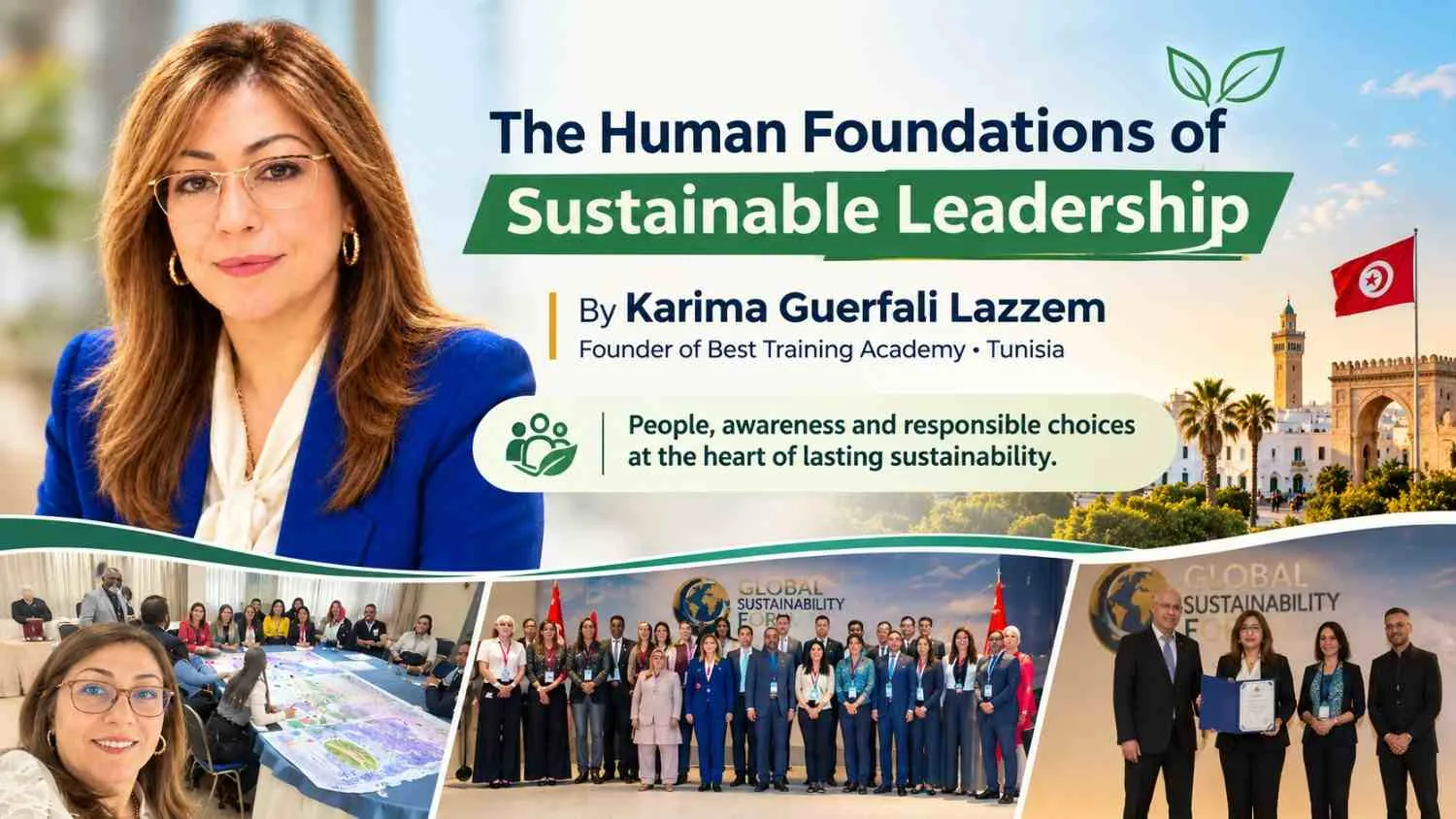
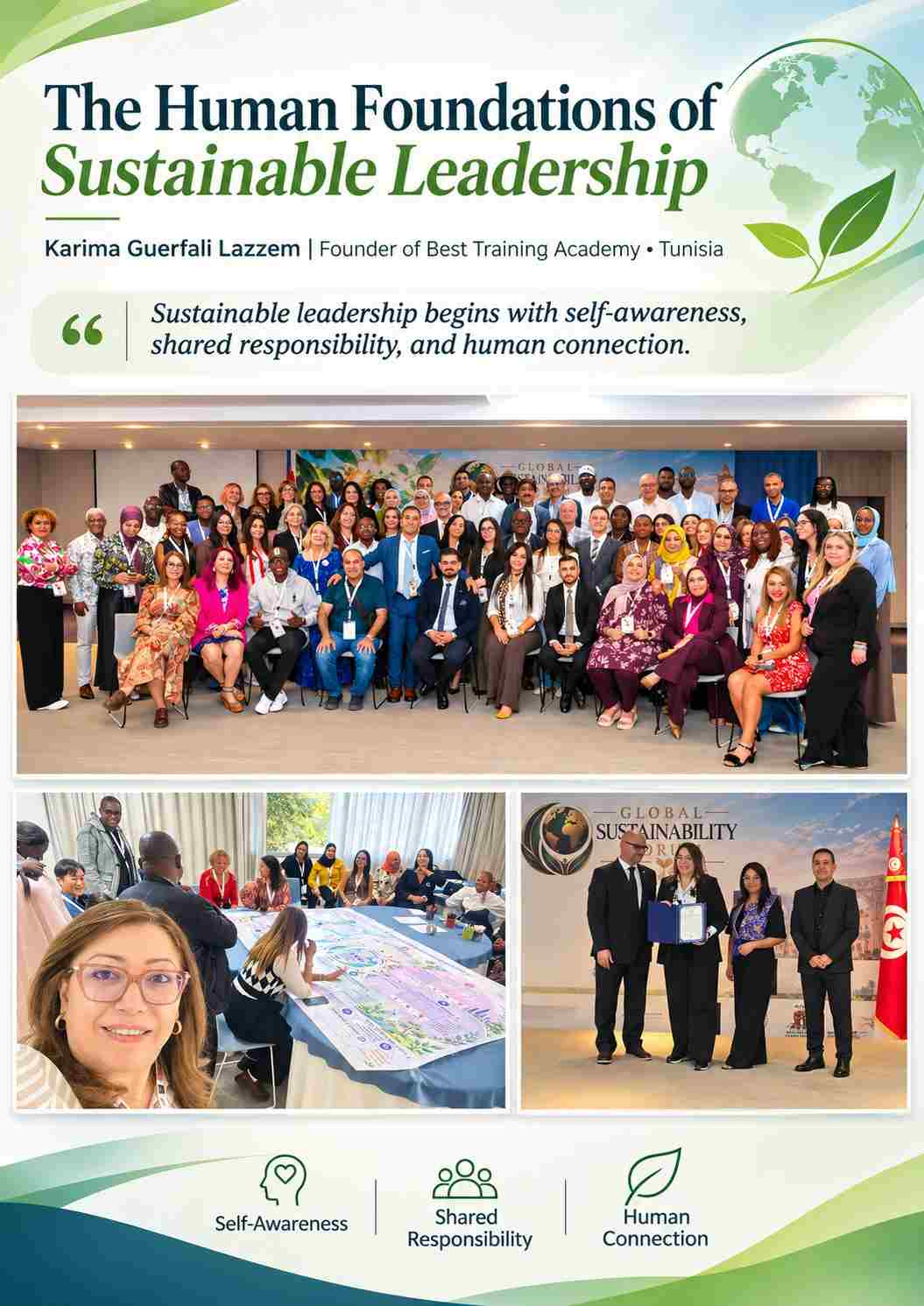
During my Responsible Leadership Fresco workshop at the Global Sustainability Forum in Tunis, one participant described a connection she had never seen so clearly before : the relationship between self-awareness, team management, change and performance. The experience led her to revisit a situation she had lived through with her team. What stayed with me was the depth of her reflection. She was looking again at her own experience, with a different understanding of the people involved and of her role among them.
Another participant shared the experience of a colleague who had felt pressured to make decisions that did not reflect his values. Others spoke about discovering obstacles they had not previously recognised, or realising that a personal choice can affect others and eventually return to influence the person who made it. These exchanges gave a very human meaning to our discussions about sustainability.
I am Karima Guerfali Lazzem, founder of Best Training Academy in Tunisia, a trainer and coach, and creator of the BTA Leadership System® and the Responsible Leadership Fresco. My contribution to sustainable development grows from my work with people: how they understand themselves, communicate, cooperate and take responsibility for their decisions. I believe these capacities deserve a central place in the way we prepare leaders for change.
Through BTA, I work on leadership, communication, team dynamics, emotional awareness and collaborative problem-solving. My training approach gives substantial space to practice, discussion and reflection on real situations. Participants are invited to examine their assumptions and consider how their behaviour affects colleagues and the quality of collective work. This is the educational and social dimension of my contribution to sustainability. It also creates opportunities to bring environmental responsibility into everyday leadership decisions.
A manager navigating change may need to listen to concerns, explain difficult choices and recognise tensions between short-term demands and longer-term consequences. In my view, learning to do this responsibly matters for sustainable development. Decisions about resources, working conditions or organisational priorities are made by people whose values, fears and relationships influence what happens in practice.
I developed the BTA Leadership System® to help participants explore these connections. Its Responsible Leadership Fresco provides a shared visual space where people can connect ideas, discuss lived experiences and consider possible actions.
The seven interconnected zones form the core reflective journey. Dragons represent obstacles along the way; Antidotes invite participants to explore responses and resources. Accelerators help them consider what additional support could make action possible, while Impact brings attention to the consequences of their choices.
The dragons provide a way to speak about difficulties that can otherwise remain unspoken. A participant may recognise a fear, an internal conflict or a pattern that limits the options they can see. Identifying that obstacle opens a conversation about the resources needed to respond. Sometimes recognising a resource is still insufficient: putting it into practice may require support from others, a different working environment or an additional capacity. This is where the discussion of accelerators becomes useful.
The participant who described her colleague’s conflict of values brought this journey into focus. Her account connected a difficult professional decision with the obstacles surrounding it and the support a person might need to act more consistently with their values. I cannot know the colleague’s full circumstances from that account, but the discussion showed how the Fresco could make room for a complex human situation without reducing it to a simple instruction.
Another reflection concerned the wider effects of personal decisions. Participants considered how a choice that feels individual can affect a team and its environment, and how those effects can return to shape their own situation. For me, this awareness is closely connected to responsible leadership. It encourages a person to consider who else is involved, which values are at stake and what consequences deserve attention before acting.
These are qualitative participant reflections, rather than a formal evaluation of behavioural change or organisational performance. They nevertheless matter to my work. Receiving them brought me great joy and strengthened my motivation to refine the Fresco and offer it more widely, while continuing to learn from the people who use it.
This work takes place in Tunisia, where sustainable development combines important progress with urgent challenges. One concrete achievement is the commissioning of the 120 MWp Kairouan solar photovoltaic plant in December 2025. The African Development Bank identifies it as the country’s first project to exceed 100 megawatts of installed capacity, marking an important step in Tunisia’s energy transition. [1]
A second recent milestone is the approval, in March 2026, of US$332.5 million in World Bank financing for the first phase of Tunisia’s Water Security and Resilience Program. It supports projects for potable water services and irrigated agriculture. Securing this financing is a significant step; the expected improvements in services and livelihoods remain outcomes to be delivered and assessed. [2]
Water scarcity remains a major challenge. In September 2026, the World Bank reported that Tunisia had approximately 380 cubic metres of renewable freshwater available per person each year, below the threshold for absolute water scarcity. The same report highlights unequal employment outcomes: women’s unemployment stood at 21.6 per cent in the second quarter of 2026. [3] These challenges connect environmental resilience with livelihoods and inclusion. They also underline the need for institutions and leaders able to engage people in difficult changes.
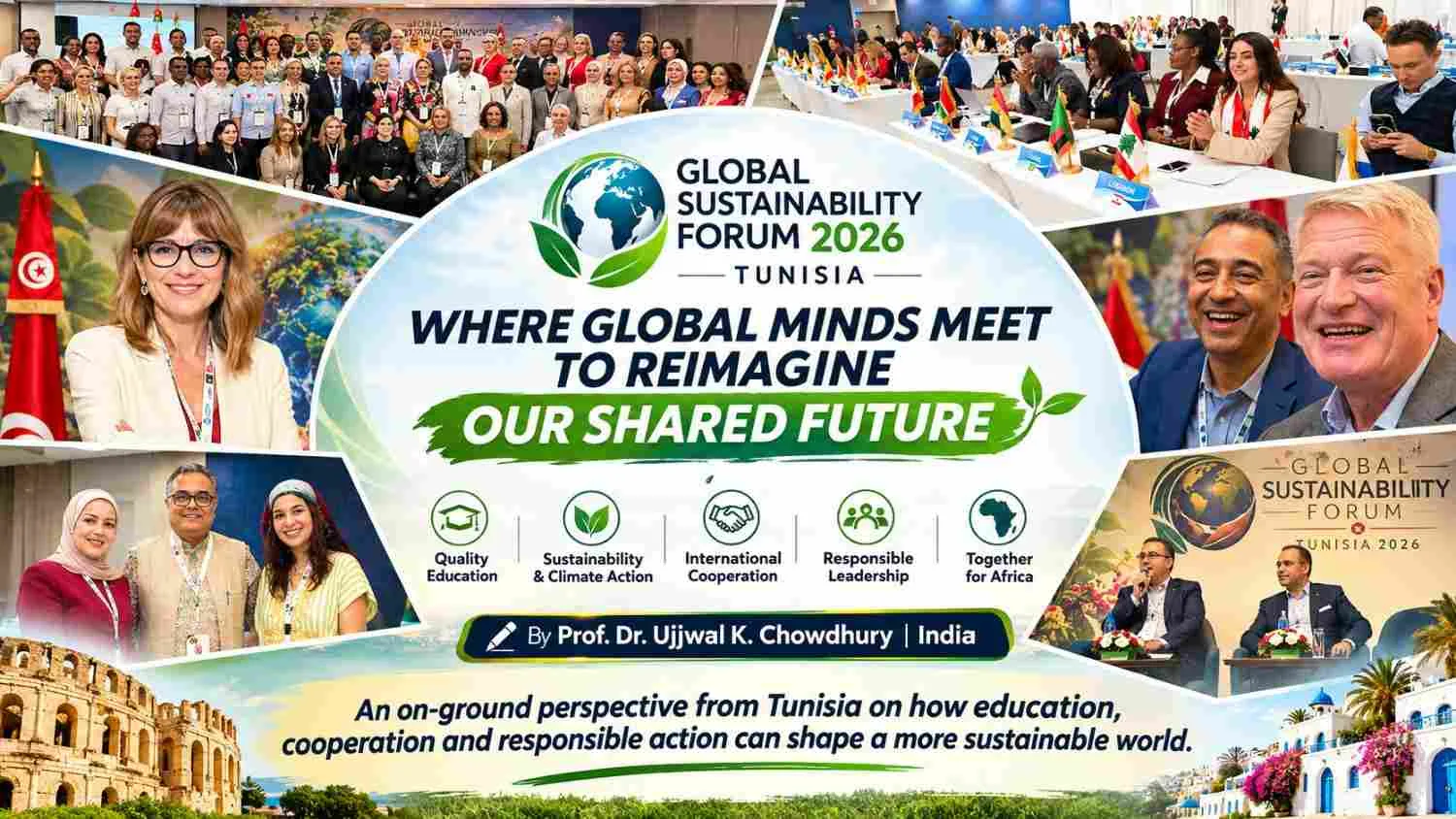
The Global Sustainability Forum gave me an opportunity to explore these questions as both a learner and a facilitator. My participation followed six months of learning, with more than fifteen online sessions, and included four days of in-person activities, workshops, a United Nations simulation and a presentation leading to the Global Sustainable Ambassador certificate. I also contributed an online session on responsible leadership and facilitated the Responsible Leadership Fresco in person.
Learning alongside people from different countries, engaging with cases and discussing development priorities helped me place my own work within a broader context. The United Nations simulation invited me to consider national priorities alongside shared challenges. Facilitating the Fresco gave me something equally valuable: the chance to hear how participants connected responsible leadership with their own lives and teams.
I leave this experience wanting to make those connections more explicit in BTA’s future work. I intend to bring more sustainability-related dilemmas into leadership learning and to develop follow-up opportunities through which participants can revisit the actions they choose. Their reflections will also guide the continued development of the Fresco, including how it helps people identify obstacles and the support they need to move forward.
The workshop reminded me how much can emerge when people have time and space to look honestly at an experience. I want to keep creating that space, and help participants carry what they discover into the decisions they make with their teams and communities.
Sources:
1. African Development Bank, 19 December 2025. Tunisia: commissioning of the 120 MWp Kairouan solar photovoltaic project.
Read source
2. World Bank, 1 April 2026. Tunisia: Major Push to Strengthen Water Security and Resilience. Board approval dated 31 March 2026.
Read source
3. World Bank, 22 September 2026. Stronger Water Management Could Unlock Growth, Protect Jobs, and Build Resilience in Tunisia.
Read source
About the author
Karima Guerfali Lazzem is the founder of Best Training Academy in Tunisia, a professional trainer and coach, and creator of the BTA Leadership System® and the Responsible Leadership Fresco. Her work focuses on leadership, communication and experiential learning.
https://besttrainingacademy.com

Add a Comment