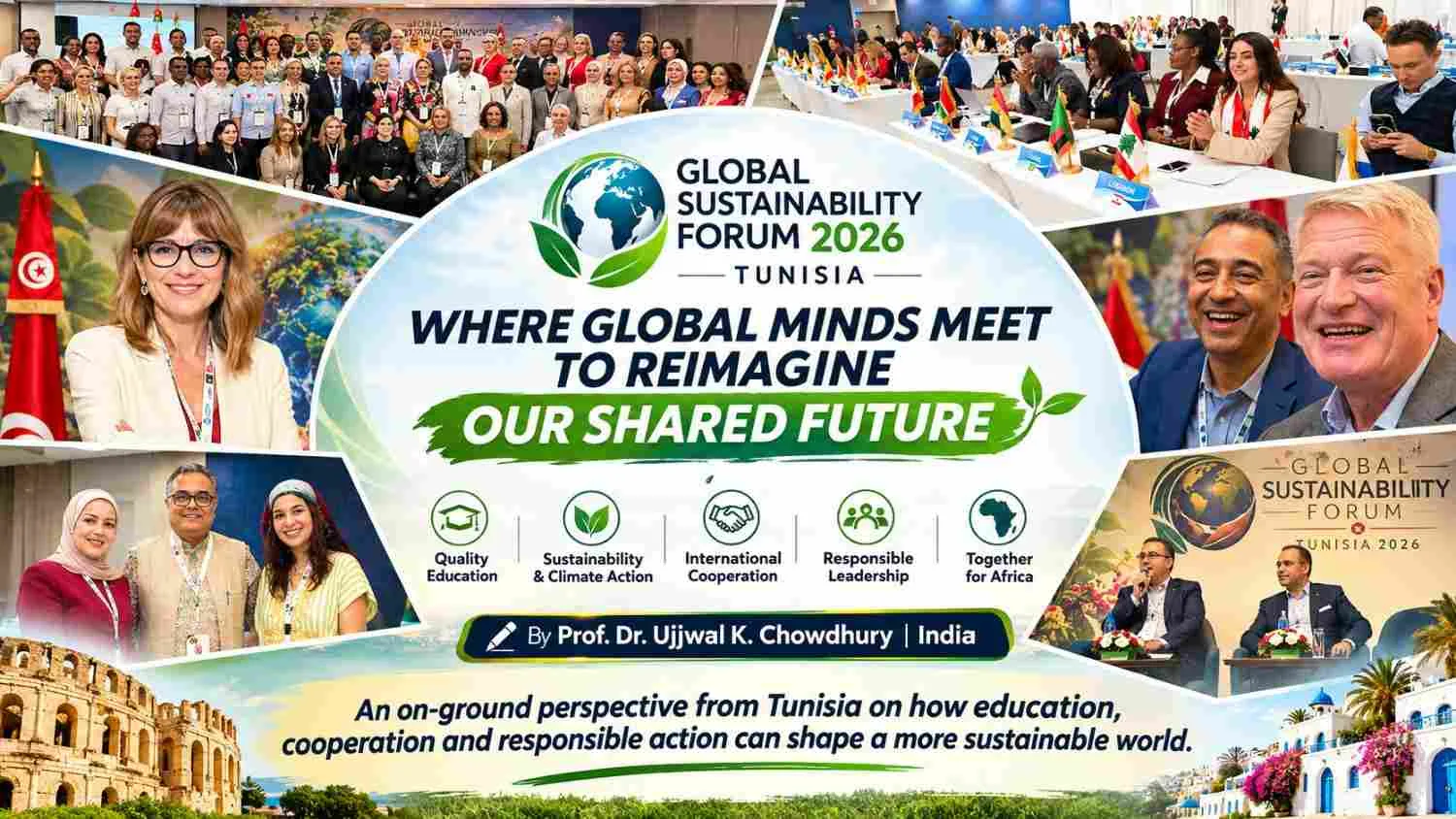
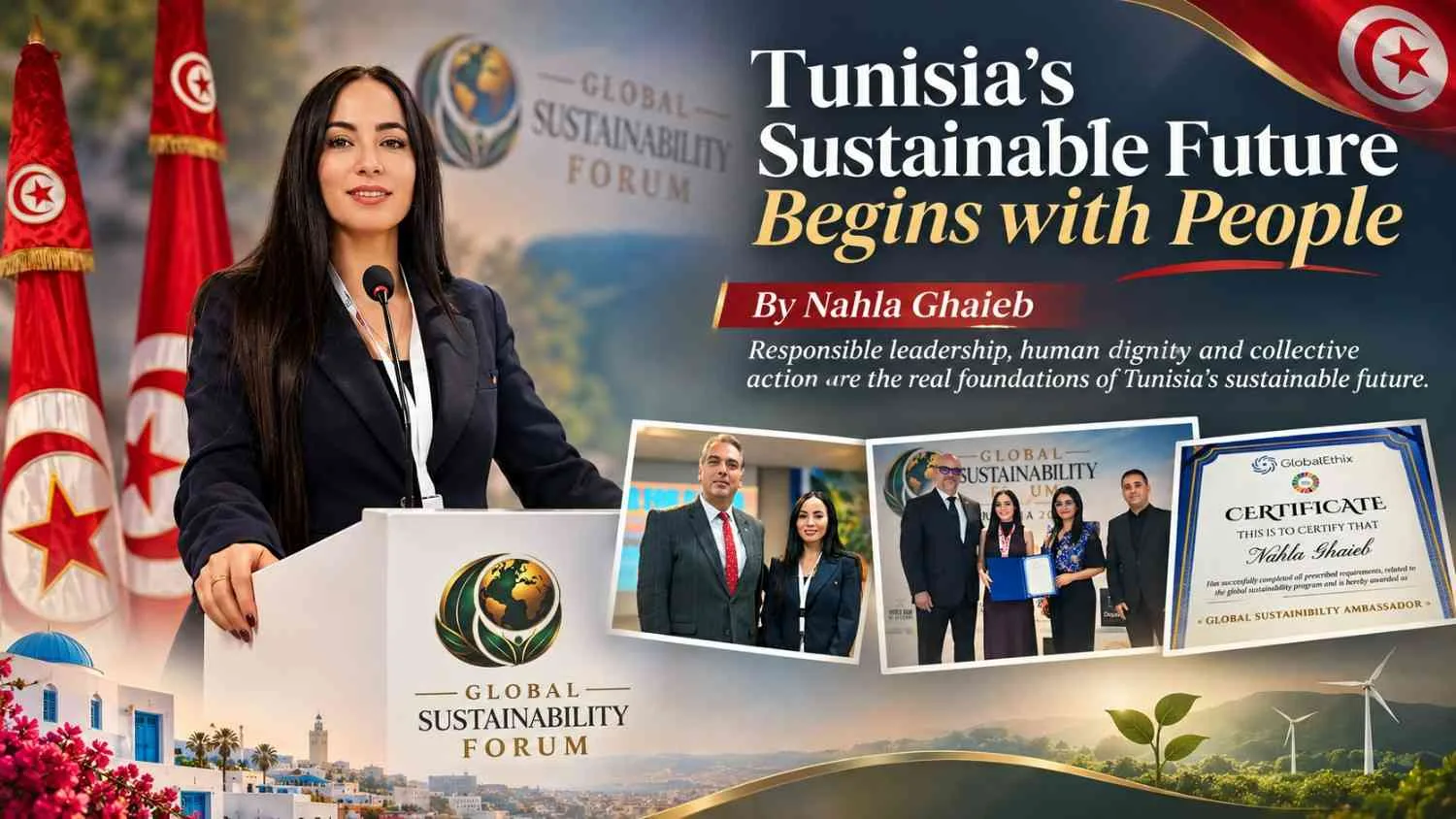
| From climate justice and responsible leadership to quality education and ethical artificial intelligence, the Global Sustainability Forum in Tunisia brought together voices from across continents, united by the conviction that a better world is not merely possible, but our collective responsibility. |
A Meeting of Minds, A Convergence of Hope
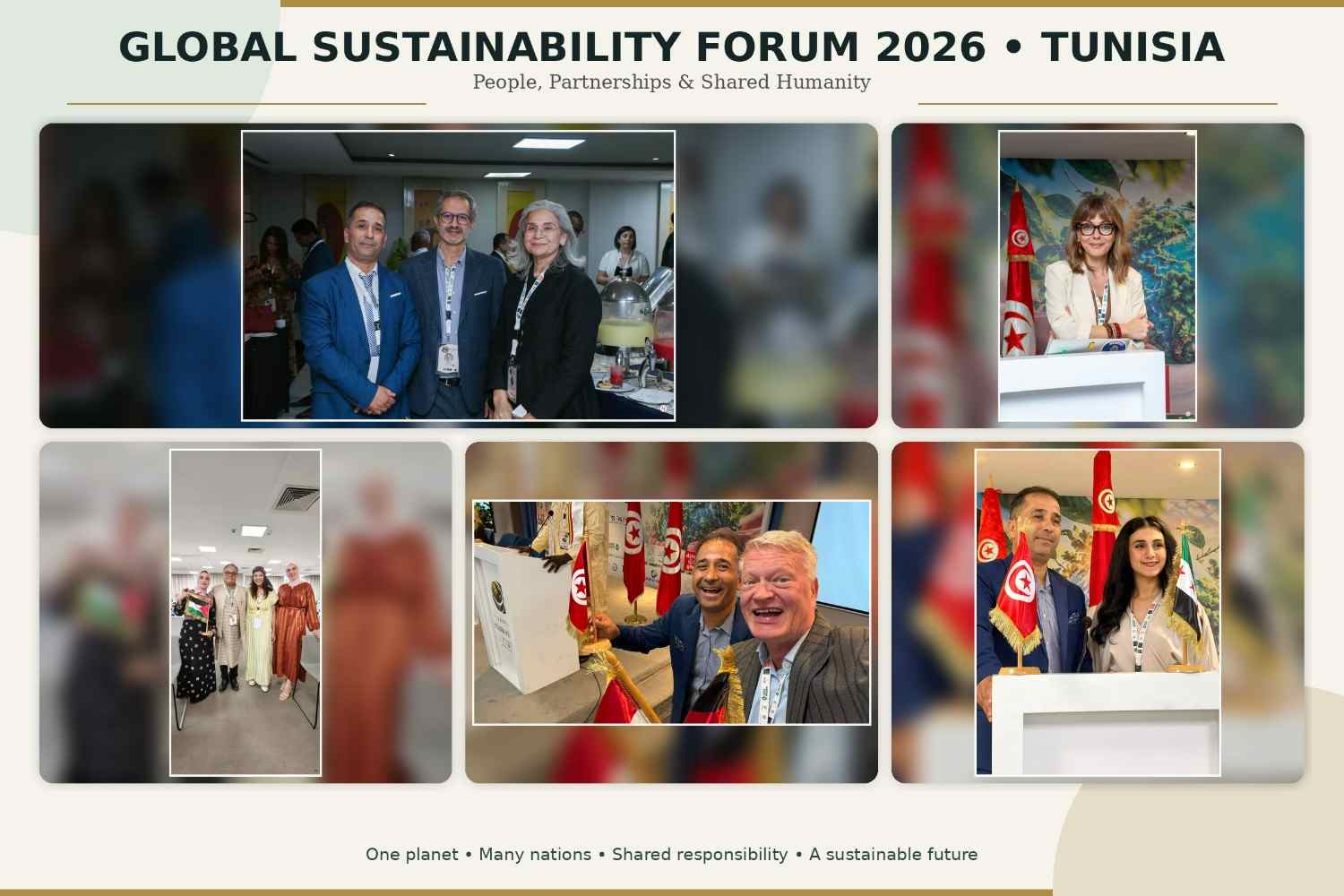
There are conferences that share knowledge, gatherings that create connections, and occasionally, extraordinary encounters that inspire us to reconsider our responsibilities towards humanity and the planet. The Global Sustainability Forum (GSF) 2026, held in Tunis, Tunisia, from 24 to 27 October, aspired to become such a gathering.
For me, travelling from India to this beautiful North African nation, the Forum represented something larger than an international sustainability event. It was an opportunity to discover how people from different continents, cultures, professions and generations could find a common language of responsibility towards our shared future.
Organised by Global Goals Connections, with international partners including GlobalEthix and RELTTAW, the Forum brought together sustainability advocates, educators, entrepreneurs, professionals and emerging leaders. Participants representing more than 40 nationalities contributed to a fascinating exchange of perspectives.
At the Golden Tulip El Mechtel in Tunis, the atmosphere was characterised by conversations that transcended geographical boundaries and professional identities. People arrived with different experiences and priorities, but shared a fundamental aspiration: to leave the world more equitable, peaceful and environmentally secure than we inherited it.
The most powerful message was also the simplest: Sustainability is not somebody else's responsibility. It belongs to every individual, institution, community and nation.
Tunisia: A Beautiful Nation Confronting a Changing Climate
Tunisia provided a particularly meaningful setting for such conversations.
A land of extraordinary Mediterranean beauty, ancient civilisations, vibrant markets and remarkable cultural heritage, Tunisia also stands at the frontline of several environmental challenges confronting North Africa.
According to the World Bank's September 2026 assessment, Tunisia has approximately 380 cubic metres of renewable freshwater available per person annually, significantly below the threshold for absolute water scarcity. Without adequate adaptation, worsening water scarcity could reduce the country's GDP by 6.4% by 2050.
The challenges extend beyond water. Rising temperatures, coastal erosion, pressure on agriculture and changing rainfall patterns threaten livelihoods, particularly among vulnerable communities.
Yet Tunisia is not simply a story of environmental vulnerability. It is also a country exploring pathways towards resilience through improved water management, climate adaptation, renewable energy and international cooperation.
During my travels, Tunisia's magnificent historical heritage and natural landscapes offered a reminder that sustainability must protect more than ecosystems. It must preserve culture, livelihoods, community identities and the wisdom accumulated across generations.
The Forum's location therefore carried profound symbolism. In a land where ancient civilisations have left their footprints, the world had assembled to discuss the footprints our generation will leave behind.
Day One: From Corporate Responsibility to Responsible Civilisation
The Forum opened on 24 October with a welcome address by Christian Levesque, President of GlobalEthix International, followed by the introduction of international partners, distinguished speakers and sustainability trainers.
The inaugural sessions established a crucial connection between ethical leadership, responsible business and sustainable development.
The central learning programme focused on Corporate Social Responsibility (CSR), Environmental, Social and Governance (ESG) principles, and the ESG 1000 framework. Led by Christian Levesque and Ziad Kadhi of GlobalEthix, the sessions challenged participants to reconsider the meaning of organisational success.
For decades, business performance has largely been measured through financial returns, expansion, market share and shareholder wealth. But can an enterprise truly call itself successful when its profits are accompanied by environmental destruction, social inequality or exploitation of natural resources?
The discussions encouraged a different understanding of prosperity.
A responsible business must not merely create wealth. It must examine how that wealth is generated, who benefits from it, and what environmental and social costs are imposed on present and future generations.
A significant development reinforcing this message was the introduction of ISO/UNDP 53001:2026, published in September 2026. This international management-system standard offers organisations a structured approach to integrating the United Nations Sustainable Development Goals into strategy, governance, operations and measurable performance.
The message was unmistakable: sustainability must move from annual reports and ceremonial commitments into the everyday decisions of institutions.
The future will not judge organisations only by what they earned, but also by what they protected, restored and contributed to humanity.
Day Two: Climate Justice Is Ultimately Human Justice
The morning of 25 October shifted the conversation from institutional responsibilities towards human values, personal transformation and community relationships.
Nathaly Khoury's workshop on Climate Change and Environmental Justice highlighted an uncomfortable global reality: those contributing least to environmental degradation are frequently among those suffering its worst consequences.
Climate change is not equally experienced.
For a prosperous community, rising temperatures may mean additional energy expenditure. For a struggling farmer, they may mean a failed harvest. For coastal communities, rising seas may mean the loss of ancestral homes. For vulnerable children, environmental disasters can interrupt education, nutrition and healthcare.
Climate justice, therefore, cannot be separated from economic justice, gender equity, public health and human dignity.
This discussion reinforced a conviction I have developed through my work with communities in India's Sundarbans: the environmental crisis must never be understood exclusively through scientific measurements or carbon statistics. Behind every climate-related number are human lives, interrupted aspirations and uncertain futures.
A truly sustainable world must protect people alongside nature.
Learning Sustainability Through Participation
One of the more engaging experiences was Ziad Kadhi's I Nove You workshop, developed in collaboration with GlobalEthix and Key Values.
Using interactive learning and gamification, the session encouraged participants to reflect on sustainability, organisational maturity, responsible decision-making and behavioural transformation.
It demonstrated an important educational principle: people often understand complex challenges more deeply when they participate in discovering solutions rather than merely listening to explanations.
Mariem Ben Tanfous subsequently explored conflict resolution as an essential ingredient of cooperation and sustainable societies.
At first glance, conflict management may seem distant from environmental sustainability. In reality, the connection is fundamental.
Communities cannot build lasting resilience without trust. Organisations cannot achieve responsible growth without dialogue. Nations cannot solve shared environmental challenges through confrontation alone.
Peace, cooperation and mutual understanding are therefore not peripheral concerns. They are foundations of sustainable development.
Together, these workshops conveyed a powerful idea: a sustainable planet requires not only greener technologies, but also wiser human relationships.
Quality Education: Where Sustainable Futures Truly Begin
The second half of 25 October brought particular significance for me as an educationist.
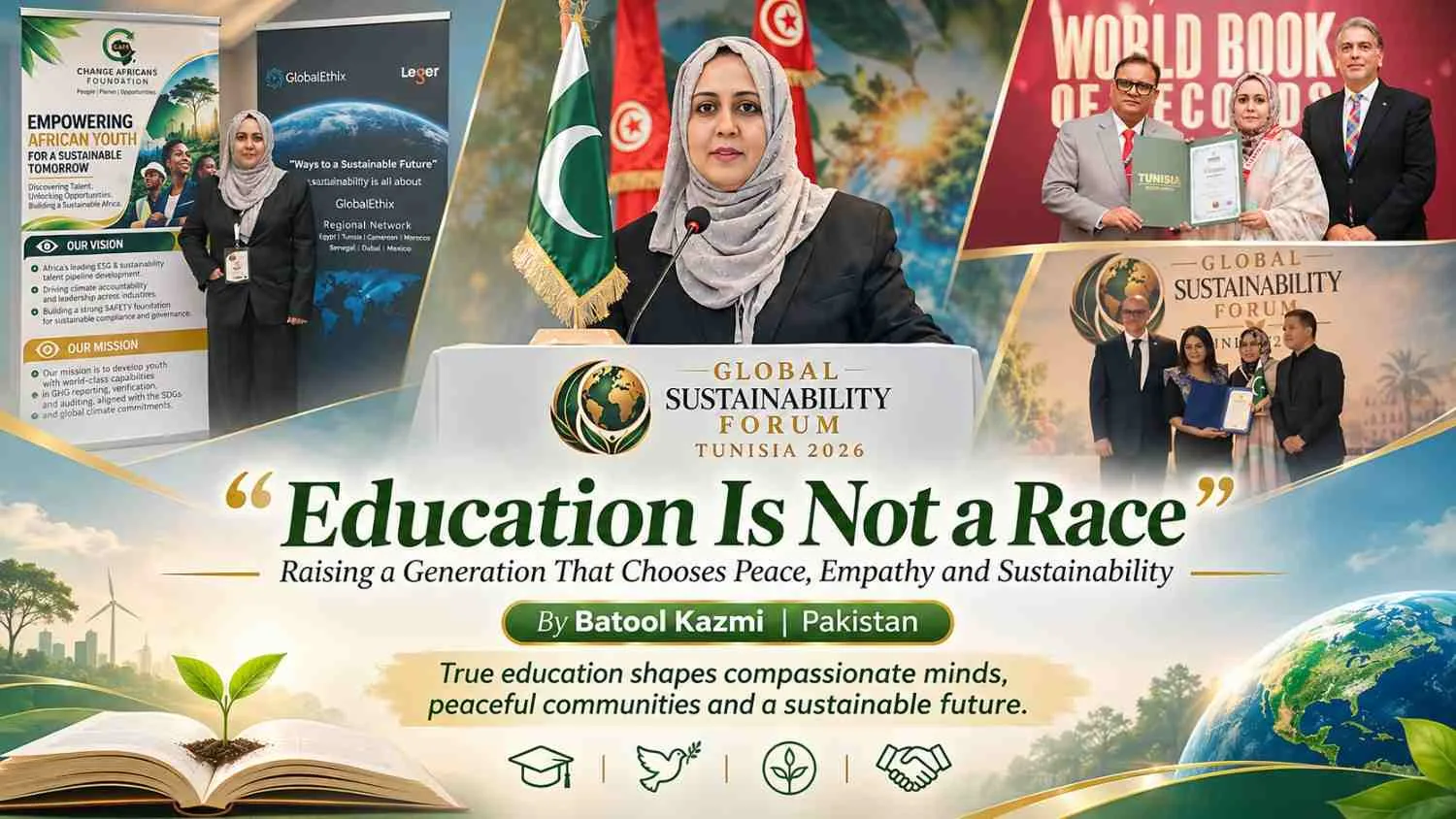
The Forum's Quality Education programme, involving the international educational organisation RELTTAW, focused on the transformative contribution of schools, universities, educators and young people towards achieving the Sustainable Development Goals.
A major highlight was the presentation of the vision behind Together for Africa, an international initiative connecting education, sustainability, climate responsibility and community development.
The initiative, supported by leaders and collaborators including Corina Sujdea from Romania, Imed Krayem from Tunisia, Ezzat Hassan from Egypt and others, reflected an important understanding: Africa's sustainable future must be built through its people, particularly its youth, educators and communities.
Following the education discussions, the project was formally launched on 26 October.
The significance of this endeavour extends beyond geographical boundaries. It raises an essential question: what would happen if educational institutions across Africa became living laboratories of sustainable development?
Imagine campuses where students participate in water conservation, renewable energy initiatives, waste reduction, sustainable agriculture, community health programmes and local entrepreneurship.
Imagine universities that measure their success not simply through academic degrees, but also through the communities they transform.
The Together for Africa vision offers an opportunity to develop such relationships between educational institutions, sustainability practitioners and communities.
Education Must Create Responsible Citizens, Not Merely Qualified Graduates
The Quality Education workshop facilitated by Ms. Tamara from the United States encouraged reflection on educational purpose, learning practices and the responsibilities of educators.
Delegates from Romania also presented a case study of their education system, providing an opportunity to examine educational approaches across national contexts.
These exchanges were especially relevant against a disturbing global backdrop.
According to the United Nations Sustainable Development Goals Report 2025, approximately 272 million children and young people remained outside school in 2023. Many more attend institutions that lack essential infrastructure or struggle to deliver meaningful learning outcomes.
Access to education remains vital. But access without quality, inclusion, curiosity and relevance cannot fulfil the promise of SDG 4.
The great challenge before educators is to move beyond producing examination-ready students towards developing life-ready, socially conscious and environmentally responsible citizens.
A genuinely educated person should understand not only how to earn a livelihood, but also how to respect human diversity, protect natural resources, question injustice and contribute to society.
Education must prepare young people not simply to succeed in the world as it exists, but to improve the world they inherit.
Responsible Artificial Intelligence: Technology with a Human Conscience
It was my privilege to address the Quality Education session on the Ethical and Responsible Use of Artificial Intelligence in School and Higher Education.
Artificial intelligence is rapidly transforming teaching, learning, research and institutional management. Used appropriately, AI can support personalised learning, assist teachers, facilitate multilingual education, expand access to knowledge and help students explore complex subjects.
For resource-constrained educational systems, these possibilities are particularly significant.
Yet technological progress without ethical direction can create new inequalities.
Algorithms may reproduce biases. Students' personal information may be exposed. Excessive dependence on automated answers can weaken independent thinking. Educational institutions may adopt technology without adequately preparing teachers or protecting learners.
UNESCO's guidance on generative AI in education reinforces the importance of human-centred approaches, data protection, age-appropriate safeguards and meaningful teacher involvement.
My central argument was that AI must strengthen human intelligence rather than replace human judgement, imagination or compassion.
An effective teacher cannot be reduced to an information-delivery mechanism. The teacher remains a mentor, motivator and guide who recognises the uniqueness of every learner.
In schools and universities, AI should help educators devote more attention to creativity, critical thinking, collaborative problem-solving and personalised mentoring.
It should also enable students to explore real sustainability challenges: local water conservation, environmental monitoring, sustainable farming, disaster preparedness and community development.
If technology helps education become more accessible, inclusive and relevant, it can contribute meaningfully to sustainability. If it merely widens the distance between privileged and disadvantaged learners, we have failed its ethical test.
From Global Conversations to Local Transformation
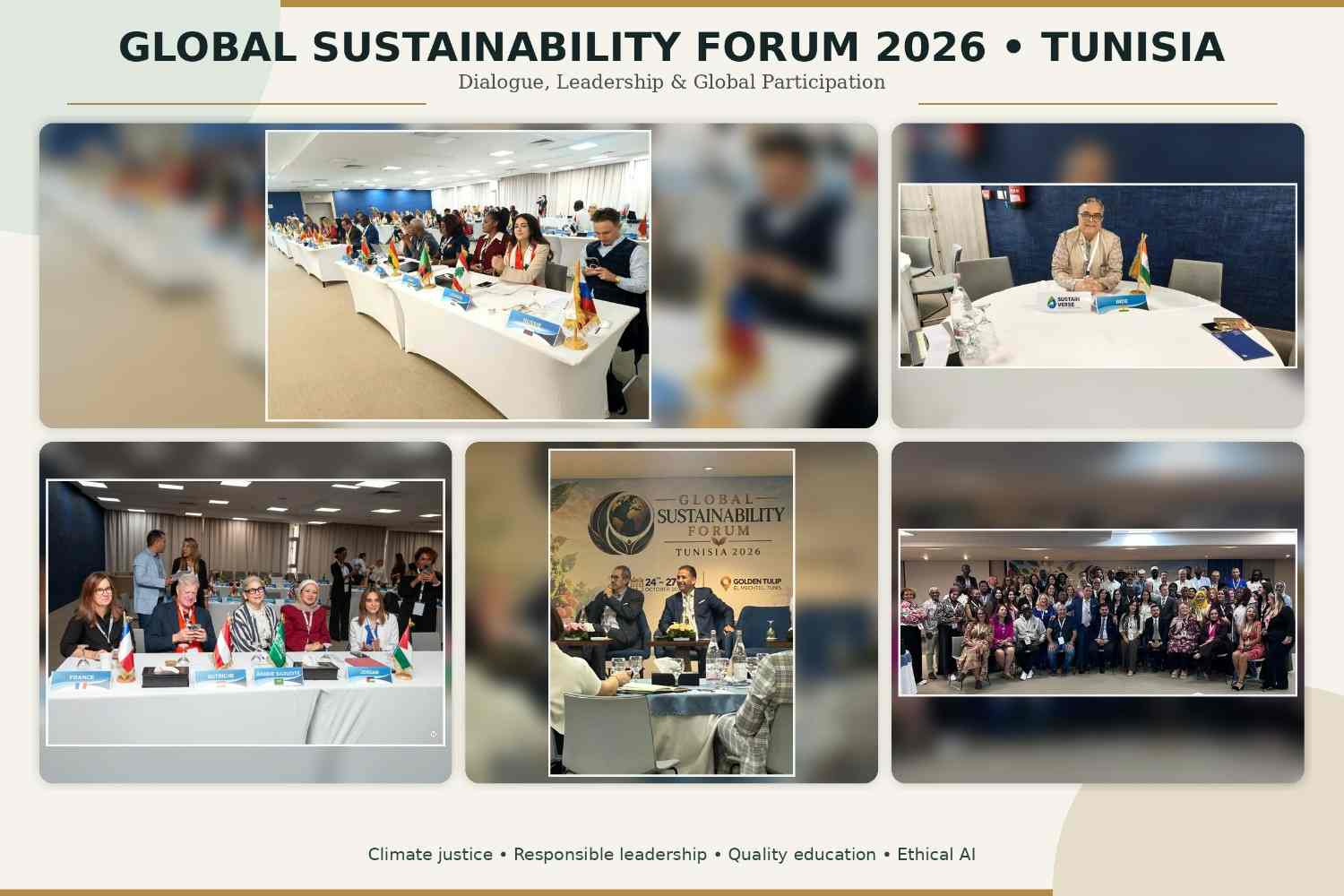
As the discussions progressed, I repeatedly returned to one conviction: global sustainability becomes meaningful only when it improves local lives.
A declaration made in Tunis must eventually find expression in an African village, an Indian coastal settlement, a European classroom or an Asian manufacturing enterprise.
The world does not suffer from a shortage of sustainability declarations. It suffers from an enormous gap between commitments and implementation.
That gap can be bridged through practical partnerships.
Businesses can adopt responsible production and governance practices. Universities can integrate sustainability into curricula and research. Schools can develop environmental literacy from childhood. Civil society organisations can mobilise communities. Governments can create enabling policies and ensure accountability.
Perhaps most importantly, young people must become active participants in designing solutions rather than passive beneficiaries of decisions made by previous generations.
The Sustainable Development Goals cannot be achieved through isolated institutional efforts. Climate action, quality education, gender equality, decent livelihoods, reduced inequalities and peaceful societies are deeply interconnected.
We must therefore move from fragmented interventions towards integrated approaches to development.
A Forum Ends. A Responsibility Begins.
What made the Global Sustainability Forum memorable was not only its diversity of sessions, but also its extraordinary human connections.
Across nationalities, languages and professional backgrounds, conversations revealed how frequently our aspirations converge despite our different circumstances.
We want clean water, healthy communities, meaningful education, dignified livelihoods, peaceful societies and a liveable planet for future generations.
SustainVerse, as a media partner of the Forum, has an important role in carrying these conversations beyond conference halls, amplifying promising practices and connecting people committed to positive change.
For me, Tunisia was a reminder that the sustainability movement must combine knowledge with empathy, ambition with humility, and innovation with responsibility.
The value of such international gatherings should ultimately be measured not by photographs, certificates or speeches, but by the collaborations sustained, institutions transformed and lives improved afterwards.
I returned from Tunisia with renewed faith in the possibility of collective human progress, but also a deeper recognition of the urgency before us.
Our generation stands at an extraordinary crossroads. We possess unprecedented scientific knowledge, technological capability and economic resources. Yet we are simultaneously confronting environmental instability, inequality, conflict and uncertainty.
The choice before us is not between development and sustainability. It is between development that diminishes our collective future and development that makes that future possible.
The planet does not need a few extraordinary people practising sustainability perfectly. It needs millions of ordinary people, institutions and communities making responsible choices consistently.
And perhaps that is the enduring message of the Global Sustainability Forum 2026.
We may belong to different nations, speak different languages and carry different histories. But the air we breathe, the oceans that connect us, the climate that sustains us and the aspirations of our children remind us that humanity shares one common destiny.
One planet. Many nations. Shared humanity.
One responsibility. One opportunity. One sustainable future to build together.
| Hashtags: #GlobalSustainabilityForum2026 #Tunisia #SustainVerse #SustainableDevelopment #ClimateJustice #QualityEducation #ResponsibleAI #ESG #GlobalGoalsConnections #TogetherForAfrica #SustainableLeadership |
About the Author
Prof. Dr. Ujjwal K. Chowdhury is an Indian media and education scholar, institution-builder and sustainability advocate associated with educational transformation, social development and international collaborations. He participated as a speaker in the Quality Education session of the Global Sustainability Forum 2026 in Tunisia. His work connects responsible technology, education, communication and community development.
Add a Comment