
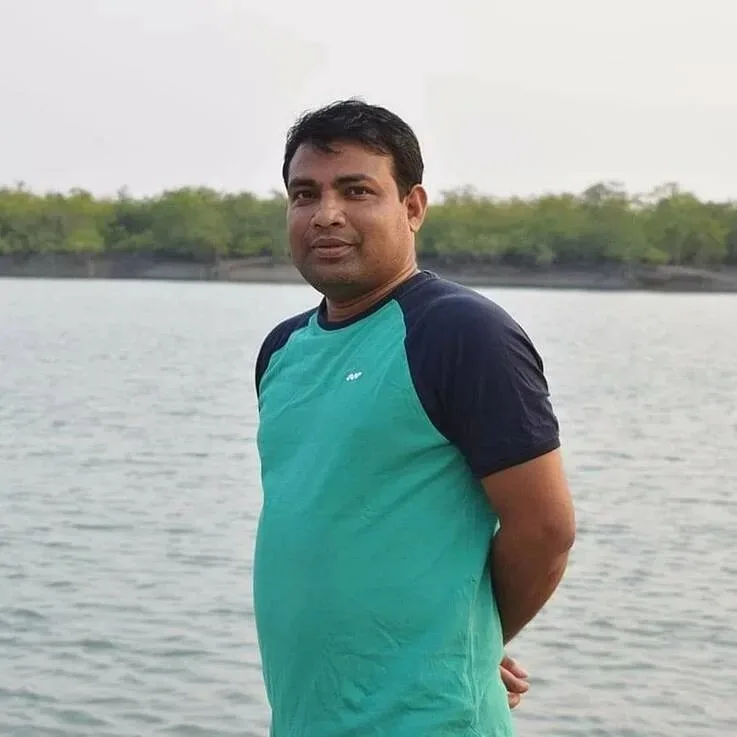
About Umashankar Mandal
The Teacher Who Grew a Living Shield
An inspirational profile feature by Victor Bhattacharya
The tide does not ask permission before entering Chargheri.
At the southeastern edge of the Indian Sundarbans, the river rises quietly, surrounds the mudflats and presses against the embankments protecting fragile settlements. Across the water lies tiger territory. Behind the embankments are homes, ponds, farms, schools and generations of memories.
Between the river and the village now stands another line of defence: a dense belt of mangroves.
This forest was not created through one government order, one corporate grant or one ceremonial plantation drive. It grew from the determination of a geography teacher who had seen his own home collapse and his community become homeless.
His name is Umashankar Mandal.
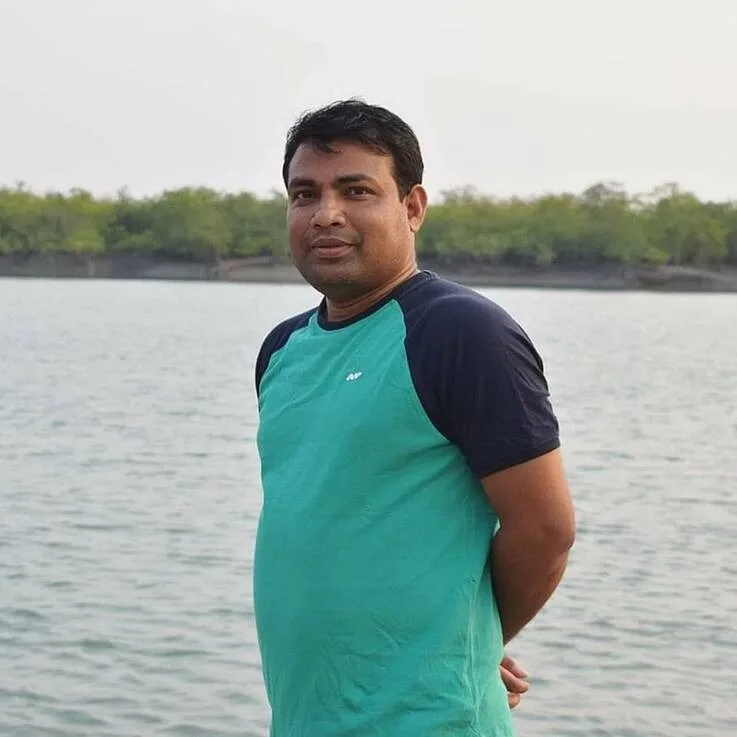
The people of the Sundarbans call him the Mangrove Man. But that title captures only part of his work. Mandal is also a teacher, environmental organiser, social worker, writer, researcher, advocate for tiger widows and builder of a community-based ecological movement.
His mission is remarkably simple—and profoundly ambitious.
“In one word, I am trying to create a socio-ecological balance.”
The Day the Water Won
The turning point came on May 25, 2009, when Cyclone Aila struck the Sundarbans.
Its storm surge broke embankments, flooded villages with saline water, destroyed crops, uprooted trees and reduced thousands of homes to mud and debris. Chargheri, Mandal’s native village on Satjelia island, was among the severely affected settlements.
As the embankment gave way, Mandal and some friends tried to block the rushing water with their own bodies. Human strength, however, was no match for the swollen river.
His mud house collapsed. Families were displaced. Agricultural land became saline. The green cover along stretches of the shoreline disappeared.
“Aila gave us a lesson. I can’t forget it,” Mandal later recalled.
The geography teacher began searching for a lasting answer. Concrete structures alone would not be enough. Embankments repeatedly weakened under tidal pressure, erosion and storm surges. The islands needed a defence system that could grow stronger with time.
His answer was the mangrove.
When Geography Walked Out of the Classroom
Mandal was born and raised in Chargheri before moving to Murshidabad to teach geography. But after Aila, geography ceased to be merely a school subject for him.
It became a survival science.
He understood that mangrove roots could trap sediment, stabilise shorelines and reduce the force of waves. Their tangled roots could create habitats for fish, crabs and other aquatic life. The trees could also provide shelter for birds, support honeybees and help rebuild a damaged food web.
Scientific institutions describe mangroves as natural coastal infrastructure. Their roots reduce erosion, weaken wave action, trap sediment and create habitat for aquatic species. Mangroves are also among the planet’s most carbon-rich ecosystems, storing large quantities of carbon in their biomass and soils.
But Mandal did not begin with a laboratory, a large budget or an institutional workforce.
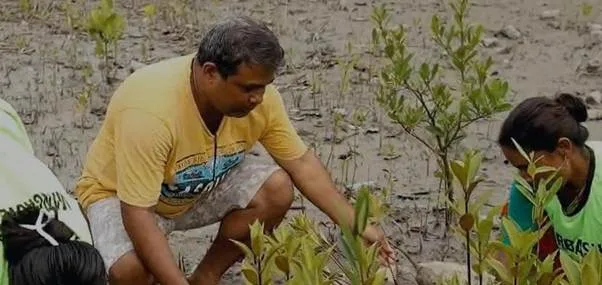
He began with seeds, mud and people.
One Sapling Became More Than a Million
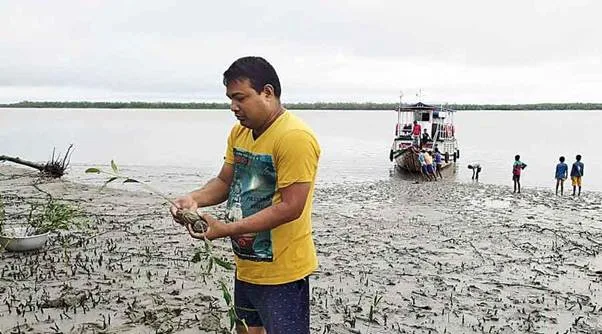
Mandal and a small group of associates started collecting mangrove seeds and planting them along exposed riverbanks. They returned repeatedly to protect the seedlings from grazing, tidal damage, theft and human disturbance.
The work demanded something rarely visible in photographs of plantation ceremonies: maintenance.
A sapling planted is not necessarily a tree saved. It must be placed in a suitable tidal zone, matched with the right soil and salinity, monitored through changing seasons and protected for years.
By 2021, Mandal and 135 associates had planted more than 650,000 mangrove saplings along the embankments of Gosaba and Satjelia islands. Residents said that the resulting vegetation helped protect their settlements during Cyclones Amphan and Yaas.
A January 2025 report placed the cumulative plantation at approximately 1.1 million saplings. By June 2026, Mandal was being described as having planted more than 1.3 million across the region.
In an updated account supplied for this profile, Mandal records 1,338,000 mangrove plantations across four islands as of July 27, 2026.
The number is impressive. The diversity behind it is even more important.
His plantations include garan (Ceriops decandra); bine species such as Avicennia alba, A. marina and A. officinalis; garjan or “thunder” mangrove (Rhizophora mucronata); kankra (Bruguiera gymnorhiza); dhundul (Xylocarpus granatum); pashur (Xylocarpus mekongensis); keora (Sonneratia apetala); gewa (Excoecaria agallocha); sundari (Heritiera fomes); and salt-tolerant dhani grass (Porteresia coarctata).
This is not monoculture plantation. It is an attempt to restore an ecosystem.
The Forest Began Breathing Again
As the mangrove belt thickened, life began returning.
Microscopic algae, larger algae and aquatic grasses supported the lowest levels of the food chain. Fiddler crabs of different colours appeared across the mudflats. Mud crabs, horseshoe crabs and other benthic organisms began occupying the newly protected habitat.
Herons, kingfishers, kites, parrots and common mynas found feeding and nesting spaces. After severe storms damaged natural nesting sites, Mandal says he installed artificial nests on around 500 trees.
As flowering vegetation expanded, bee movement increased. Fish and shrimp found nursery spaces among the roots. Local families began placing nets closer to the village forests rather than travelling into dangerous creeks deep inside tiger territory.
Mangroves elsewhere are also recognised as vital nurseries for fish and shellfish, nesting and feeding sites for birds, and shelters for a wide range of organisms.
A plantation had become a forest.
And the forest had become a livelihood system.
A Mangrove Army Led by Mothers
Mandal’s greatest innovation may not be the number of trees he planted. It may be the number of people he persuaded to believe that those trees belonged to them.
He formed a Mangrove Army of local residents, with women emerging as its strongest guardians. They collect floating seeds, prepare nurseries, plant saplings and monitor vulnerable stretches of embankment.
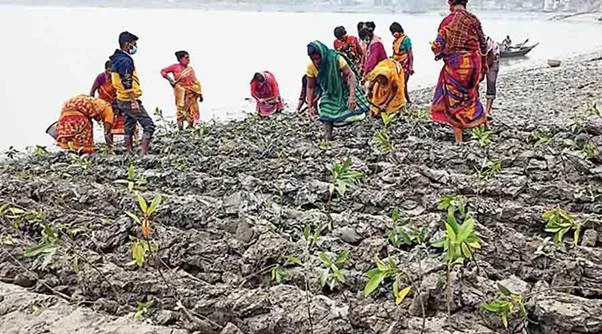
Women were strategically important. They spent much of their day near ponds, riverbanks, fishing areas and household plots. They could observe damaged plants, grazing, cutting or attempted theft long before an outside organisation could respond.
In 2023, The Indian Express documented how Mandal had mobilised mothers in Chargheri to build and protect a community forest. The initiative stood out because local people were not treated as temporary labourers; they were made stakeholders in the forest’s survival.
On New Year’s Day in 2025, around 500 women associated with the Mangrove Army launched a drive to plant and protect 50,000 saplings. Each participant was assigned responsibility for approximately 100 trees for three years. At least 200 participants were reported to be women whose husbands had been killed by tigers.
This approach transforms afforestation from an event into stewardship.
A tree does not need a chief guest. It needs a guardian.
The Women Whom Society Called Inauspicious
In the Sundarbans, the phrase “tiger widow” describes a woman whose husband was killed while fishing, catching crabs or collecting honey in tiger territory.
But the death is often only the beginning of her suffering.
Many such women face social stigma, isolation and poverty. Some are blamed for their husbands’ deaths or branded inauspicious. Families may be denied compensation when the deceased entered the forest without an official permit or crossed an unclear boundary into a core area.
Mandal understood that conservation would fail if desperation kept forcing families deeper into dangerous forests.
Through the Purbasha Eco Helpline Society, he and his associates began providing relief, livelihood support and opportunities for tiger widows to participate in mangrove restoration. His updated account says more than 120 women have received assistance at different times.
In one initiative, participating tiger widows were to receive ducks and hens after planting saplings. The purpose was not charity detached from responsibility. It linked an alternative livelihood with ecological guardianship.
The woman received productive assets. The forest received a long-term protector.
“We are trying to create a sustainable model,” Mandal explained while describing this relationship between livelihood support and forest responsibility.
This is sustainability in its fullest sense—not simply protecting a tree, but reducing the economic compulsion that causes environmental destruction.
A Forest Cannot Survive Beside a Broken Society
Mandal’s work gradually expanded beyond plantations.
Pond renovation became necessary because cyclones and saline intrusion damaged freshwater sources. Medical camps were organised because remote island communities had limited access to healthcare. Menstrual-health initiatives and sanitary-napkin distribution addressed the neglected needs of women and adolescent girls.
Mangrove nurseries created local participation and reduced dependence on saplings transported from elsewhere. Environmental workshops introduced residents and visiting students to the ecology of the delta.
The movement thus crossed conventional boundaries between conservation, health, education, gender and livelihood.
This integration reflects Mandal’s central belief:
“If we want to develop trees, we have to develop people side by side.”
A hungry family cannot be lectured about biodiversity. A child without education may never understand why a wetland matters. A widow without income may have no option except to return to the forest that took her husband.

Therefore, saving the Sundarbans requires more than planting trees. It requires strengthening human dignity.
Children Who Learn Beneath a Climate Threat
Mandal established the Purbasha Rural Child Education Centre as part of his conservation model.
In 2023, one centre in Chargheri was reported to have 80 young students, many of them children of Mangrove Army members. Classes combined Bengali, English and mathematics with poetry, storytelling, art and environmental learning rooted in the Sundarbans.
According to Mandal’s updated figures, Purbasha now supports the education of approximately 200 children across three islands.
This may be one of his most far-reaching contributions.
A mangrove planted today may live for decades. But a child who learns why that mangrove matters can protect hundreds of trees, influence a family and reshape the decisions of an entire community.
In Mandal’s classroom, the river is a textbook. The mudflat is a laboratory. The mangrove seed is a lesson in resilience.
A Tiger Award for a Man Who Plants Trees
At first glance, mangrove planting and tiger conservation may appear to be separate causes. In the Sundarbans, they are inseparable.
Healthy mangroves sustain the habitat, prey base and ecological stability on which the Royal Bengal tiger depends. Stronger village-side mangrove barriers can also discourage or complicate tiger entry into settlements, potentially reducing dangerous encounters.
In 2021, WWF selected Mandal for the Dr. Rimington Award, presented to individuals making highly commendable contributions to wild-tiger conservation. That year’s theme was “Living with Tigers,” and WWF recognised Mandal’s decade-long restoration of mangrove habitat in his community.
The recognition changed neither his clothes nor his working ground.
“It puts more responsibility on me,” he said after receiving the honour.
His biographical account also lists the Best Bengali of the 21st Century recognition in 2023, the Savior of Biodiversity Award and Edulite Excellence Award in 2024, and a proposed special recognition by the West Bengal Tourism Department in 2026. These distinctions are cited here on the basis of information supplied by Mandal; the WWF honour is the most extensively documented by independent and institutional sources.
The Teacher Becomes an Author
Mandal has also tried to preserve the Sundarbans through words.
He serves as general editor of a geography and environment magazine and has worked on books dealing with the ecology, people, tragedies and resilience of the region. His supplied bibliography includes Prasanga Sundarbans, Surviving Sundarbans: Tragedy and Hope, writings on tiger attacks and tiger widows, and the poetry collection Cloud, Rain, River.
In June 2026, a book co-authored by Mandal and Debaroti Das on tiger widows and their struggles was released at an Aliah University seminar organised with the Purbasha Eco Helpline Society. The gathering brought together geographers, researchers, engineers, conservationists and social workers to discuss sea-level rise, saline intrusion, embankments, biodiversity and livelihood insecurity.
He also assists Indian and international students interested in researching the Sundarbans.
The practitioner thus becomes a bridge between field experience and academic inquiry.
The Lesson of Umashankar Mandal
The climate crisis is often presented through enormous numbers—global temperatures, billions of tonnes of emissions, millions of displaced people and trillions in projected losses.
These figures matter. But they can make individuals feel powerless.
Mandal’s life offers a different message.
He began where he stood.
He used the knowledge he possessed.
He worked with the people around him.
He continued when the cameras left.
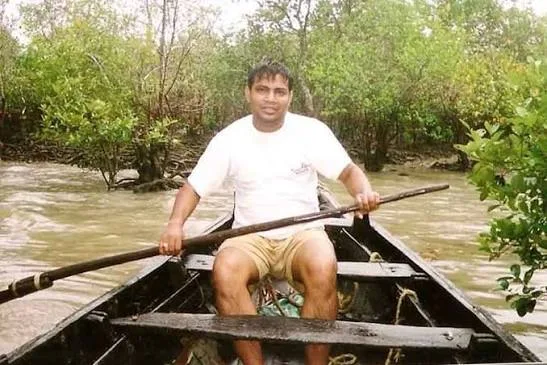
He did not plant only fast-growing saplings for impressive statistics. He developed nurseries, diversified species, returned to maintain plantations, involved women, educated children and connected environmental restoration with alternative livelihoods.
His work demonstrates that genuine sustainability has at least four roots: science, community ownership, social justice and long-term care.
Recent global restoration experience similarly shows that community-led conservation works best when it combines scientific planning, local knowledge, education, livelihood support and years of protection rather than relying on plantation numbers alone.
Do Not Wait to Become Powerful
Umashankar Mandal is inspirational precisely because he did not begin as a powerful man.
He was not a minister controlling a department. He was not the head of a multinational foundation. He did not command an army of engineers.
He was a teacher from a remote island whose house had fallen before the force of a cyclone.
What he possessed was grief transformed into purpose.
Today, the Mangrove Army he helped build is far more important than any individual title. The women protecting their allotted trees, the children learning the language of the delta, the widows building new livelihoods and the villagers guarding nurseries are the real continuation of his work.
Mandal’s appeal is addressed to everyone who believes that nature and humanity can still be defended:
“Come forward in support of marginalised people.”
That sentence contains the philosophy of his movement.
Do not save forests while abandoning forest-dependent people. Do not speak of climate resilience while ignoring women’s health. Do not celebrate wildlife while leaving widows without compensation. Do not organise plantation drives without maintaining the trees. Do not teach sustainability only inside air-conditioned rooms.
Walk to the vulnerable edge.
Place your hands in the mud.
Plant something that may outlive you.
And then return, again and again, until it becomes a forest.
In the Sundarbans, where every tide redraws the border between land and water, Umashankar Mandal has shown that hope is not an emotion.
Hope is a sapling protected long enough to grow roots.